
What's Happening?
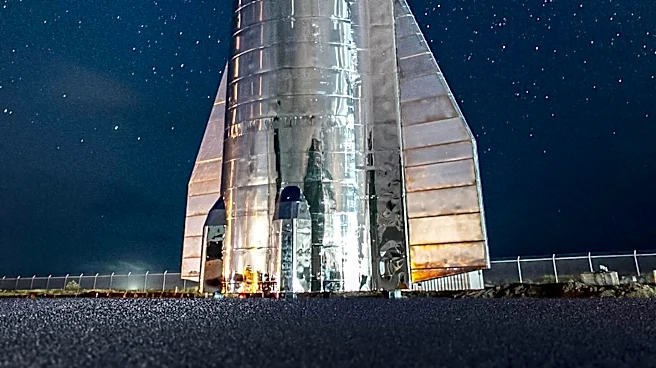
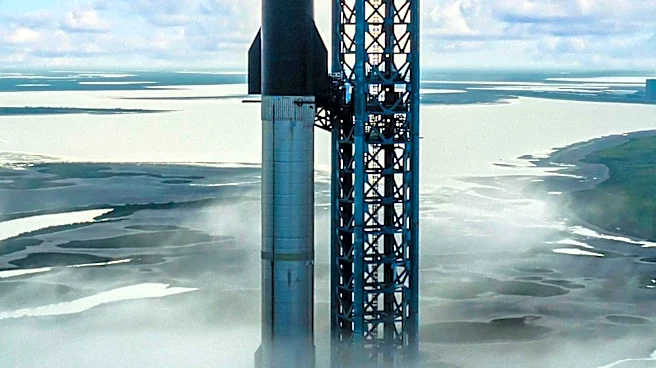
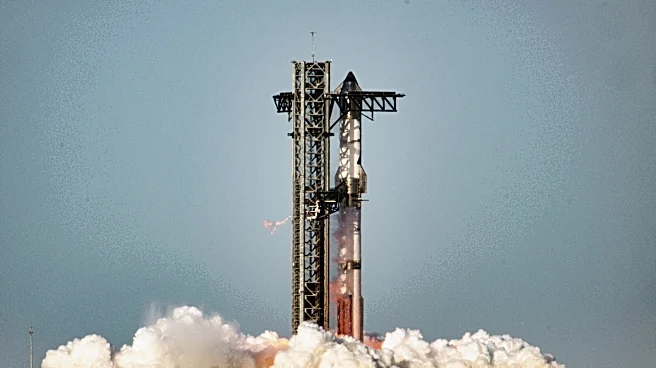
SpaceX achieved a significant milestone on November 14, 2026, by successfully catching the Starship upper stage, Ship 42, with its launch tower arms after it returned from orbit. This marked the first
time a spacecraft returning from orbit had been caught in this manner. Ship 42 spent approximately 22.5 hours in orbit, completed 14 Earth orbits, and deployed 26 Starlink V3 internet satellites before its precise landing at Starbase. However, the Super Heavy booster, which was also intended for recovery, was lost in the Gulf of Mexico due to low fuel and being off course. Concurrently, on November 15, a United Launch Alliance (ULA) Vulcan rocket carrying 40 Amazon Leo broadband satellites suffered an anomaly about ten minutes after liftoff, resulting in the complete loss of the mission and its payload. This was ULA's first outright mission failure since its formation in 2006.
Why It's Important?
This weekend's events underscore a significant divergence in the commercial space race, particularly in the satellite internet sector. SpaceX's successful Starship catch demonstrates a major step towards fully reusable orbital launch systems, which could drastically reduce the cost of space access and accelerate the deployment of its Starlink constellation. This technological advantage further solidifies SpaceX's lead in the satellite broadband market. Conversely, the ULA Vulcan failure represents a substantial setback for Amazon's Project Kuiper (now Amazon Leo), which aims to compete with Starlink. The loss of 40 satellites, the largest single Leo payload Amazon had attempted, and the potential grounding of the Vulcan rocket for an extended investigation, could significantly delay Amazon's network deployment and service plans. This incident highlights the critical importance of reliable launch capacity in the burgeoning space economy, impacting market competition and investor confidence.
What's Next?
For SpaceX, the focus will be on achieving full reusability by successfully catching both the Starship upper stage and the Super Heavy booster in future flights. This will further enhance its cost-efficiency and launch cadence for Starlink and other missions. NASA also views a higher Starship launch rate as crucial for its Artemis lunar missions. For ULA and Amazon, an intensive investigation into the Vulcan rocket failure is underway, with Blue Origin assisting due to its BE-4 engines powering the first stage. This investigation could lead to a grounding of the Vulcan rocket for several months, further delaying Amazon's satellite deployment. Amazon, which has 38 Vulcan flights booked, may need to explore alternative launch providers, including potentially SpaceX, to mitigate delays. The incident could also prompt a review of launch vehicle reliability for national security missions, as the U.S. military relies on Vulcan.
Beyond the Headlines
The contrasting outcomes for SpaceX and Amazon highlight the high-stakes nature of the new space race, where technological innovation and launch reliability are paramount. SpaceX's achievement in reusability could fundamentally alter the economics of space, making access cheaper and more frequent, which has implications for everything from scientific research to national defense. The Vulcan failure, however, serves as a stark reminder of the inherent risks in space exploration and the fragility of complex launch systems. This event could lead to increased scrutiny on launch vehicle development and testing, potentially influencing regulatory standards and insurance markets for space assets. Furthermore, the incident underscores the growing importance of space as a critical domain for global connectivity and economic competition, where the ability to deploy and maintain satellite constellations can confer significant strategic advantages.