




What's Happening?
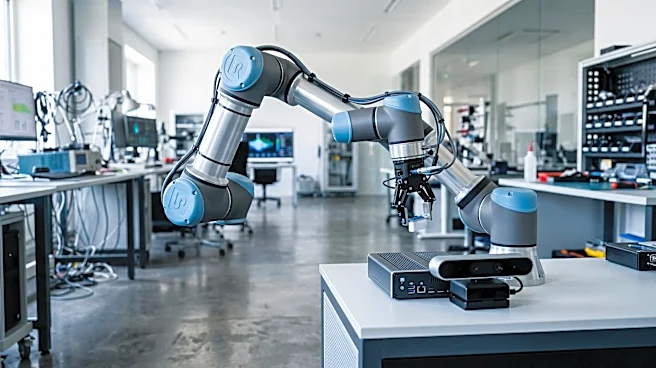
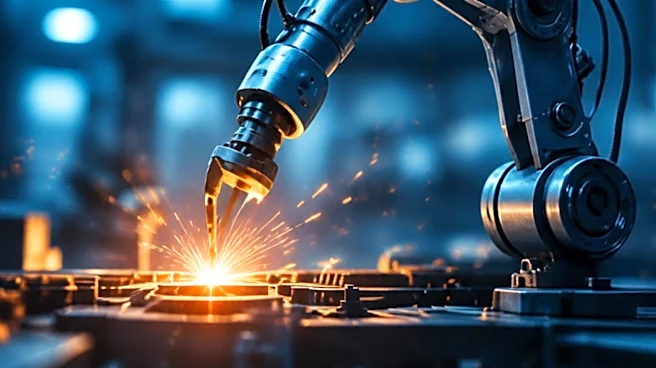
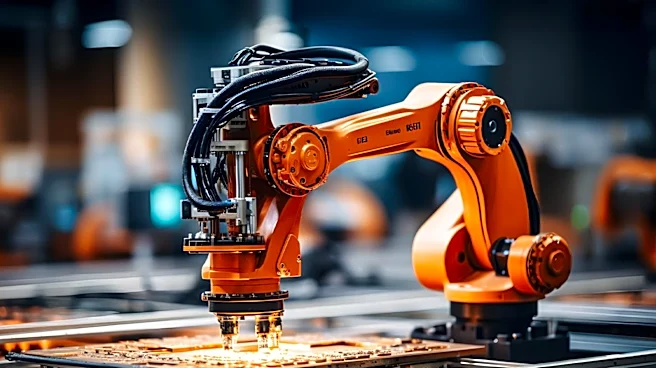
FANUC ArcTool Adaptive Welding, in conjunction with Servo-Robot seam tracking sensors, is being implemented to automatically adjust welding parameters in real-time. This technology aims to address variations in joint conditions that commonly occur from
part to part in manufacturing. By utilizing sensor feedback and robotic process control, the system can make dynamic adjustments to welding parameters based on live measurements of the joint. This capability allows manufacturers to maintain weld quality and process consistency even when faced with common fit-up variations, such as changes in gap size, joint mismatch, and weld joint geometry. The system is designed to work with various common joint types, including butt joints, V-groove joints, bevel joints, fillet joints, and lap joints, improving weld consistency across different components and throughout a single part.
Why It's Important?
This advancement in robotic welding technology is significant for U.S. manufacturing industries, particularly those involved in automotive, aerospace, and heavy machinery production. The ability to automatically adapt welding parameters in real-time can lead to substantial improvements in product quality and a reduction in rework or scrap rates. For businesses, this translates into increased efficiency, lower production costs, and enhanced competitiveness. By mitigating the challenges posed by inconsistent joint conditions, manufacturers can achieve higher levels of automation and precision, which is crucial for meeting stringent quality standards and production demands. This technology also reduces the reliance on manual adjustments, freeing up skilled labor for more complex tasks and potentially addressing labor shortages in the welding sector.
What's Next?
Manufacturers evaluating robotic welding automation are expected to increasingly adopt these adaptive welding solutions. The integration of FANUC ArcTool with Servo-Robot seam tracking sensors will likely become a standard for companies seeking to improve weld consistency and manage variations in real-world production environments. Further developments may include broader application across more complex welding scenarios and integration with advanced analytics for predictive maintenance and quality control. Training programs for engineers and technicians will also be crucial to ensure effective implementation and utilization of these sophisticated robotic welding systems, driving a shift towards more intelligent and autonomous manufacturing processes.
Beyond the Headlines
The broader implications of adaptive welding technology extend to the evolution of smart factories and Industry 4.0 initiatives. This technology represents a step towards fully autonomous manufacturing processes where machines can self-correct and optimize operations without human intervention. Ethically, it raises questions about the future role of human labor in manufacturing, emphasizing the need for workforce retraining and upskilling to manage and maintain these advanced systems. Legally, the increased automation may necessitate new standards for product liability and quality assurance in automated production lines. Culturally, it signifies a continued shift towards precision engineering and data-driven decision-making in industrial settings, pushing the boundaries of what is achievable in automated production.