





What's Happening?
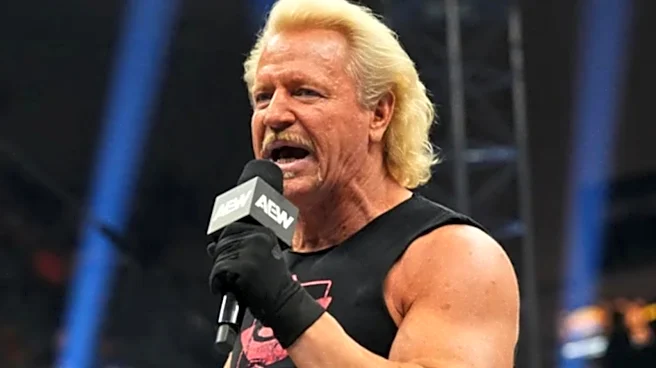
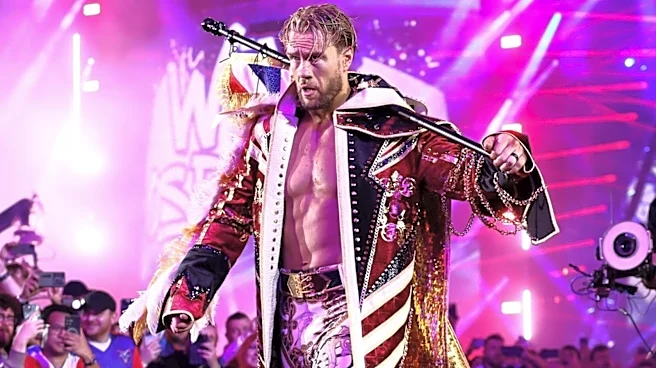
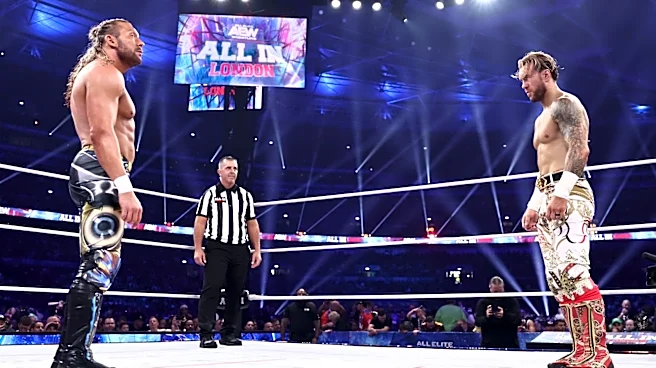
Jeff Jarrett, a prominent figure in professional wrestling, recently commented on Kenny Omega's performance during his match against Will Ospreay at AEW All In. According to Jarrett, Omega worked the main event match in a manner akin to a 'heel' (a villainous
character in wrestling) without altering his established persona. Ospreay emerged victorious, claiming the AEW World Championship at Wembley Stadium. Jarrett suggested that Omega's entrance and the pacing of the match, while staying true to his character, exhibited characteristics typically associated with a heel. He emphasized the importance of clarity in wrestling storytelling, cautioning against overcomplicating narratives to avoid confusing the audience. Jarrett's observations highlight a nuanced approach to character portrayal in professional wrestling, where a performer can subtly adopt different roles within their existing framework.
Why It's Important?
Jarrett's comments are significant for the professional wrestling industry as they delve into the art of character work and audience perception. His analysis of Omega's performance underscores the subtle ways wrestlers can influence crowd reactions and narrative direction without a complete character overhaul. This perspective is crucial for understanding how top-tier talent like Omega can maintain authenticity while experimenting with different in-ring dynamics. For AEW, it showcases the creative freedom afforded to its performers and the potential for complex storytelling. The discussion also touches upon the broader challenge of measuring success in modern wrestling, given the diverse platforms and metrics available, from traditional pay-per-view buys to digital engagement. This ongoing debate about how to quantify impact affects strategic decisions for promotions and performers alike.
What's Next?
Following Jarrett's observations, it remains to be seen how Kenny Omega's character will evolve in AEW. While Jarrett noted Omega's subtle heel-like tendencies at All In, it doesn't necessarily indicate a full-fledged heel turn. Instead, it might suggest a more complex, morally ambiguous character arc for Omega, allowing for varied storytelling opportunities. Fans and critics will likely pay closer attention to Omega's in-ring psychology and crowd interactions in his upcoming matches. The discussion also opens up a broader conversation within AEW and the wrestling community about the definition of 'heel' and 'face' (heroic character) in contemporary wrestling, potentially leading to more nuanced character portrayals across the roster. The success of such subtle shifts will ultimately be measured by fan engagement and critical reception.
Beyond the Headlines
Jarrett's insights into Kenny Omega's performance at AEW All In extend beyond a simple match analysis, touching upon the evolving nature of character presentation in professional wrestling. In an era where traditional 'good vs. evil' narratives are often challenged, Omega's ability to evoke heel-like reactions while remaining true to his established character speaks to a sophisticated understanding of performance. This approach allows for more complex storytelling, moving beyond binary characterizations and offering audiences a richer, more layered experience. It also highlights the increasing importance of subtle cues—such as entrance pacing and in-ring demeanor—in shaping audience perception. This trend could lead to a more mature and nuanced form of wrestling narrative, where character motivations and alignments are less explicit and more open to interpretation, fostering deeper engagement from the fanbase.