






What's Happening?
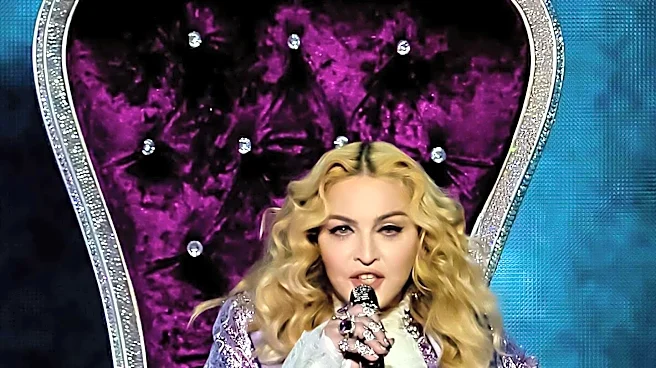
Montell Jordan, known for his hit song 'This Is How We Do It,' has revealed details about an awkward encounter with Madonna at a mid-1990s Grammys event. According to Jordan, Madonna refused his handshake and twice asked him, 'Don't I own you?' He clarified
that he perceived the remark as a 'power thing' rather than a racial one, linking it to Madonna's company, Maverick, attempting to secure a publishing agreement for his co-writer's share of 'This Is How We Do It.' Jordan's song had replaced Madonna's 'Take a Bow' at No. 1 on the Billboard Hot 100 shortly before the incident. He shared these details during an interview with Clay Cane on SiriusXM, noting that he and Madonna have not discussed the exchange since.
Why It's Important?
This revelation by Montell Jordan sheds light on the complex power dynamics prevalent in the music industry, particularly concerning publishing rights and artist control. Madonna's alleged remark, regardless of intent, highlights the often-unequal relationships between established artists, record labels, and emerging talent. For the U.S. music industry, this incident underscores the importance of artists understanding and protecting their intellectual property, especially publishing shares, which are crucial for long-term financial stability. It also brings to the forefront discussions about how power can be wielded in professional settings and the potential for such interactions to be perceived differently by those involved. The story serves as a historical anecdote illustrating the competitive and sometimes cutthroat nature of achieving and maintaining success in the entertainment world.
What's Next?
Montell Jordan's decision to revisit this past encounter comes as he embarks on a new chapter in his career, having recently released a children's picture book titled 'Shilo and the Not-So-Scary Girl Above His Bed' with his wife, Kristin Jordan. While the immediate impact on Madonna or the music industry is uncertain, Jordan's account could reignite discussions about artist rights, contractual agreements, and ethical conduct within the entertainment business. It may also encourage other artists to share similar experiences, contributing to a broader dialogue about transparency and fairness in industry practices. The renewed attention to this historical event could also draw interest to Jordan's current projects, including his new book, as audiences seek to understand his perspective and career evolution.
Beyond the Headlines
Beyond the immediate anecdote, Jordan's account touches upon the broader cultural implications of power and ownership, particularly in creative fields. The phrase 'Don't I own you?' carries significant historical weight, evoking themes of control and subjugation, which can be particularly sensitive given the racial context of the music industry. While Jordan himself framed it as a 'power thing' rather than racial, the public's interpretation may vary, sparking conversations about how such remarks are perceived across different social and racial lines. This incident also highlights the often-unseen business dealings behind popular music, where publishing rights can be a source of contention and leverage. It serves as a reminder that even seemingly casual interactions between celebrities can reveal deeper structural issues within their respective industries.