



What's Happening?
ExxonMobil Holdings has made a final investment decision (FID) on the Longtail development offshore Guyana, a project valued at $12.5 billion. This decision follows the receipt of necessary government and regulatory approvals. Longtail marks the eighth
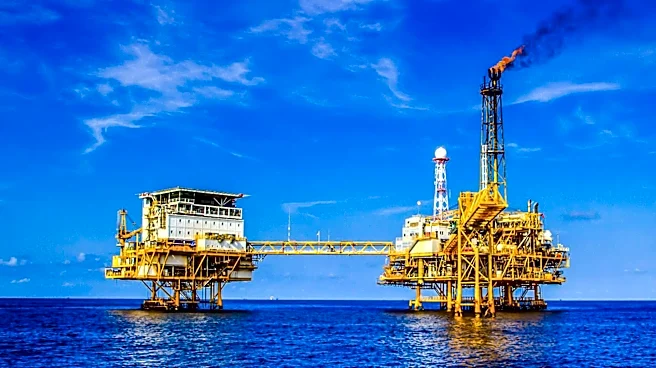
development on the Stabroek block and is projected to commence operations in 2030. This project is significant as it represents the first development on the Stabroek block specifically targeting non-associated gas and condensate-rich reservoirs located in the southeastern part of the block. The plan includes utilizing a Floating Production, Storage, and Offloading (FPSO) vessel designed to process 1.2 billion cubic feet per day (Bcfd) of gas and produce up to 250,000 barrels per day (bpd) of condensate, supported by approximately 45 subsea production and injection wells. Dan Ammann, president of ExxonMobil Upstream Co., stated that Longtail will unlock new value for Guyana and help meet growing global energy demand.
Why It's Important?
This $12.5 billion investment by ExxonMobil in Guyana's Longtail development underscores the country's growing importance as a major global energy producer and solidifies ExxonMobil's significant presence in the region. For the U.S. energy sector, this project contributes to global energy supply diversification, potentially impacting international oil and gas prices and enhancing energy security. The development of non-associated gas resources also signals a strategic shift towards a broader energy mix, which could have long-term implications for the global gas market. For Guyana, this investment promises substantial economic benefits through revenue generation, job creation, and infrastructure development. However, it also intensifies the focus on environmental stewardship and resource management in a region prone to climate vulnerabilities. The project's success will further establish Guyana as a key player in the global energy landscape, attracting more international investment and potentially influencing regional geopolitical dynamics.
What's Next?
Following the final investment decision, construction on the Longtail development will proceed with an anticipated startup in 2030. ExxonMobil will continue its operations in the Stabroek block, where it currently produces about 900,000 bpd of oil from four projects, with expectations to exceed 1 million bpd once the Uaru project begins in Q4. Construction is also underway for Whiptail, slated for 2027, and Hammerhead, expected in 2029. Future investment decisions, market demand, and the necessary infrastructure will determine if gas from Longtail will be piped to shore. The ongoing development of these projects will solidify Guyana's role as a major oil and gas producer and continue to shape ExxonMobil's global production portfolio.
Beyond the Headlines
The Longtail development in Guyana, while promising economic growth, also brings to the forefront critical environmental and social considerations. The extraction of non-associated gas and condensate, particularly at this scale, raises concerns about greenhouse gas emissions and the potential for environmental impact on marine ecosystems. The project's long-term sustainability will depend on robust regulatory oversight and ExxonMobil's commitment to minimizing its ecological footprint. Furthermore, the influx of significant oil wealth into Guyana presents challenges related to governance, transparency, and equitable distribution of benefits to avoid the 'resource curse.' The development also occurs against the backdrop of a long-standing territorial dispute between Guyana and Venezuela, adding a geopolitical layer to the energy development. The responsible management of these resources will be crucial for Guyana's long-term stability and prosperity, and for ExxonMobil's reputation as a global energy leader.