



What's Happening?
Genesis AI, a startup focused on general-purpose robots, has successfully closed a Series A funding round, raising $500 million at a valuation of $3.5 billion. This significant investment, announced on November 17, 2026, will be utilized to scale up the
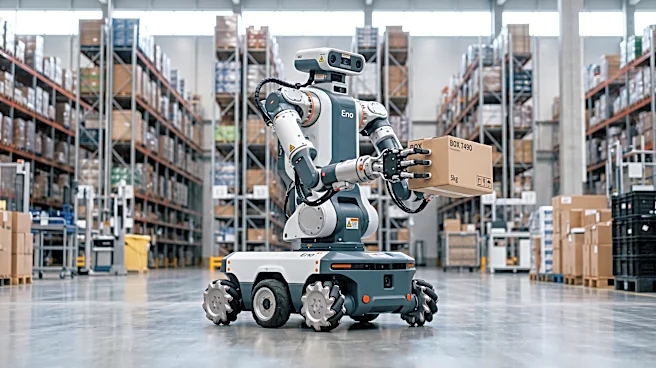
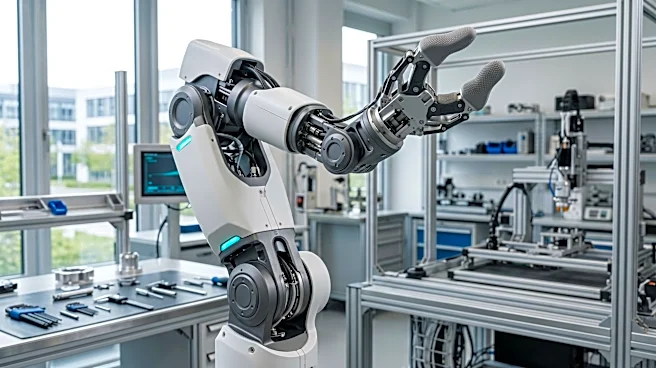
production and deployment of its robot, Eno. The company plans to expand its data acquisition efforts, enhance its artificial intelligence systems, and recruit more specialists, including AI researchers and robotics engineers. Eno is designed to prioritize manual dexterity, mimicking human hand proportions, and learns tasks through human demonstrations captured by sensor-equipped gloves. Genesis AI's strategy involves an integrated system of data, software, and hardware, with Eno serving as the physical component, supported by an AI model called GENE and a simulation platform named Genesis World. The company has already manufactured between 30 and 40 Eno units and is conducting trials with a small group of undisclosed customers, with broader deployment anticipated in 2027.
Why It's Important?
This substantial funding round for Genesis AI underscores a growing investor confidence in the future of robotics and artificial intelligence within industrial applications. The company's focus on developing robots with advanced manual dexterity, capable of learning complex tasks through human demonstration, could significantly impact U.S. manufacturing, logistics, and laboratory sectors by automating intricate processes. The investment from prominent figures and firms, including former Google CEO Eric Schmidt and Zoom CEO Eric Yuan, signals a belief in Genesis AI's potential to revolutionize workflows and address labor challenges. If successful, Eno's deployment could lead to increased efficiency and productivity across various industries, potentially reshaping job roles and creating new demands for skilled robotics and AI professionals. However, the acknowledged limitation of hardware wear and tear, with dexterous hands lasting only a few weeks, highlights a critical challenge that needs to be overcome for widespread adoption and long-term economic viability.
What's Next?
Genesis AI intends to use the newly acquired funds to accelerate the transition of Eno from trials to broader deployment. The company is preparing for industrial deployments, with an unnamed contractor selected for mass production in the United States, expected to begin next year. Initial target environments include manufacturing, logistics, and laboratories, with future plans to expand into hospitality, healthcare, and eventually consumer and outdoor applications. The company will continue to collect more data, train its systems at a greater scale, and hire additional specialists to tackle more varied and complex tasks. Addressing the current limitation of hardware durability, particularly the lifespan of Eno's dexterous hands, will be crucial for successful scaling and widespread adoption. The company's vertical integration strategy, developing its own data, technology, and hardware in-house, aims to streamline the process of bringing Eno to market and adapting it to diverse operational needs.
Beyond the Headlines
Genesis AI's approach to robotics, which prioritizes functional dexterity over human-like appearance, represents a significant philosophical shift in the development of general-purpose robots. By focusing on the '1:1:1' correspondence between human hands, sensor gloves, and robotic hands, the company is not just automating tasks but attempting to replicate and scale human-level manipulation skills. This could lead to profound ethical and societal discussions regarding the nature of work, the value of human dexterity, and the potential for robots to perform tasks previously considered exclusively human. The use of worker data, collected through sensor gloves and headset cameras, raises questions about data privacy, worker surveillance, and the ownership of intellectual property derived from human actions. Furthermore, the company's strategy of generating its own data and building its technology in-house suggests a move towards greater control over the entire robotics ecosystem, potentially influencing future industry standards and competition.