
What's Happening?
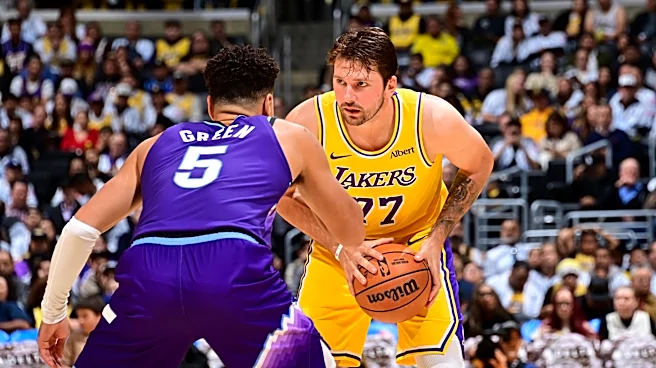
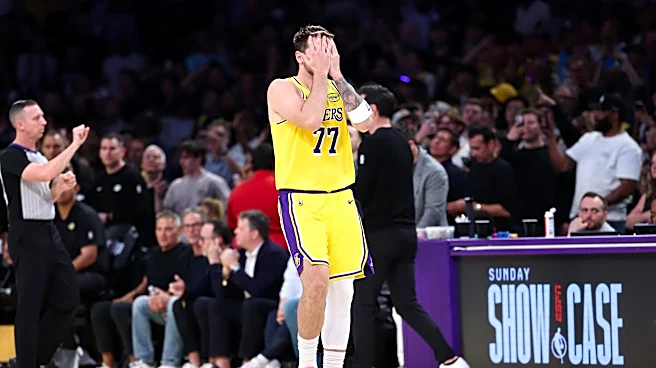
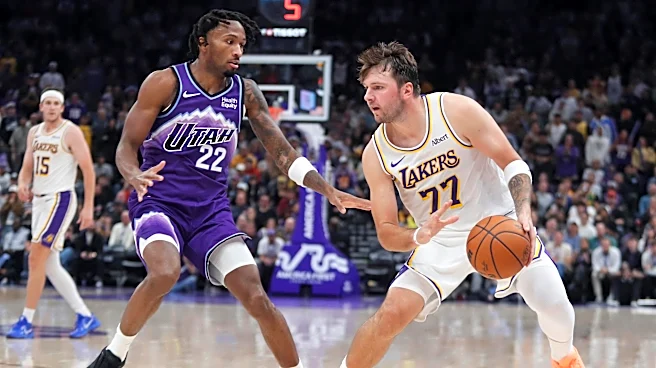
Luka Doncic, a prominent player for the Los Angeles Lakers, experienced an unusual dip in performance during a recent 109-97 loss to the Utah Jazz, ending the Lakers' nine-game winning streak. Doncic, who
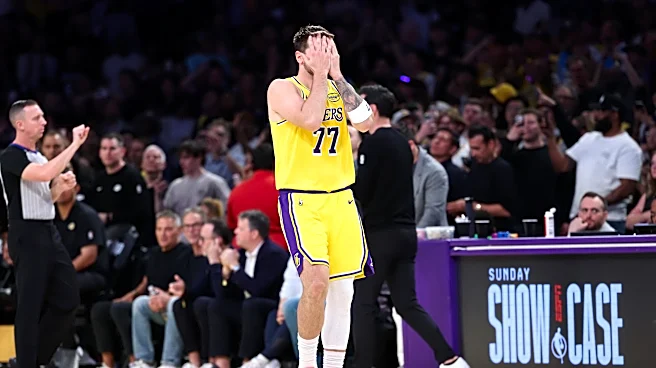
typically averages 38.1 points, 7.6 assists, and 7.0 rebounds per game, finished with 29 points, 7 assists, and 5 rebounds, alongside 9 turnovers. His shooting was notably off, hitting only 10 of 28 field goal attempts and 2 of 12 from beyond the arc. This performance marked the end of his 11-game streak of scoring at least 30 points. Following the game, his former coach, Jason Kidd, posted a message on social media, widely interpreted as a subtle critique of Doncic's approach on off-nights. Lakers coach JJ Redick, however, attributed Doncic's fatigue and high usage rate as contributing factors to his performance, especially with teammate Austin Reaves sidelined.
Why It's Important?
This event highlights the significant reliance the Los Angeles Lakers place on Luka Doncic's individual performance. His high usage rate and consistent scoring are critical to the team's success, as evidenced by their struggle when his shots are not falling. The public commentary from former coach Jason Kidd, even if indirect, underscores the pressure and expectations placed on star players in the NBA. For the Lakers, this loss, particularly against a team with a poor record like the Jazz, raises questions about the team's depth and ability to perform when Doncic is not at his peak. The absence of key players like Austin Reaves further exacerbates this issue, suggesting that the team's offensive rhythm is heavily dependent on Doncic's individual brilliance and the presence of other elite creators.
What's Next?
Luka Doncic is expected to rebound from this performance, with the Lakers scheduled to play the Sacramento Kings next. His ability to recover from fatigue and return to his usual high-scoring form will be closely watched. The potential return of Austin Reaves could alleviate some of the offensive burden on Doncic, providing additional playmaking and scoring options. The Lakers' coaching staff will likely continue to manage Doncic's minutes and responsibilities to prevent burnout over the long season. The team's performance in upcoming games, particularly against stronger opponents, will indicate whether this loss was an anomaly or a sign of deeper issues regarding their reliance on a single star player.
Beyond the Headlines
The incident touches upon the broader narrative of player fatigue and the immense pressure on star athletes in professional sports. Doncic's refusal to use fatigue as an excuse, despite his coach's acknowledgment of it, reflects a common mentality among elite competitors to take personal responsibility for their performance. This situation also brings to light the dynamics between current and former coaches, and the impact of social media on public discourse surrounding player performance. The Lakers' strategy of heavily relying on Doncic, while effective when he is performing optimally, presents a vulnerability that other teams may exploit. It underscores the ongoing challenge for NBA teams to balance individual star power with collective team strength and depth.