



What's Happening?
Nvidia has significantly expanded its Isaac robotics development platform, introducing new simulation frameworks, AI training tools, datasets, and a reference humanoid robot. These advancements, announced at GTC Berlin, aim to accelerate the development of
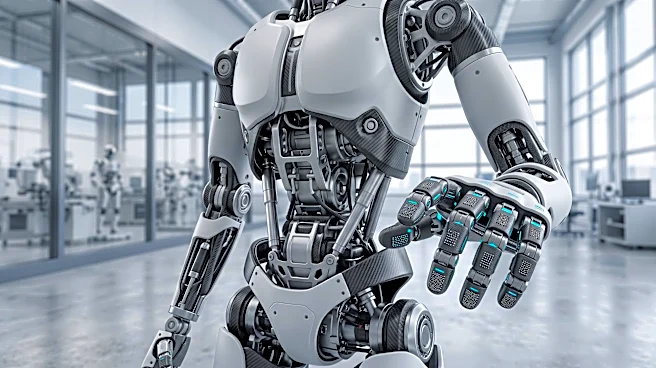
general-purpose robotic systems. Key introductions include Agile ONE SN, a humanoid research platform developed by Agile Robots, which integrates Nvidia’s Isaac GR00T foundation model and Jetson Thor computing system. This robot stands 1.4 meters tall, weighs 40 kilograms, and features 31 degrees of freedom, with two five-finger robotic hands offering 20 degrees of freedom each, tactile sensing, and force control for dexterous manipulation. Nvidia also launched Isaac OS, an open-source runtime framework designed to connect robot sensors, AI models, control systems, and hardware. Additionally, Isaac Lab 3.0 is now generally available, providing developers with tools for training robot behaviors using reinforcement learning and physics simulation. Further resources include the SimReady Central Library with over 2,000 simulation-ready assets and the Human 1M Dataset for human activity recordings and 3D hand-tracking information.
Why It's Important?
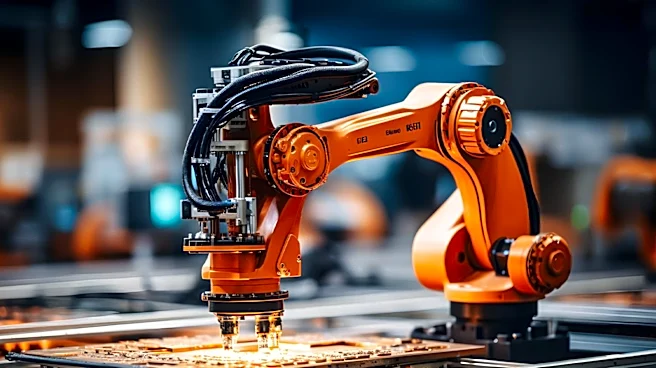
This expansion of Nvidia's Isaac robotics platform is crucial for the advancement of physical AI and general-purpose robotics, potentially ushering in what Jensen Huang, founder and CEO of Nvidia, calls the 'ChatGPT moment for robotics.' By providing comprehensive tools, models, data, and computing systems, Nvidia is enabling developers to create more adaptable and reliable autonomous systems. The introduction of the Agile ONE SN humanoid reference platform, in particular, offers a standardized hardware and software solution for researchers, simplifying the development and testing of complex humanoid capabilities. This could lead to faster innovation in areas requiring human-like interaction and manipulation. The integration of these technologies by European robotics manufacturers like ABB Robotics and Kuka, as well as the reported reduction in commissioning time by up to 50 percent in mobile robotics through simulation-based development, highlights the practical benefits and potential for significant efficiency gains across various industries. The availability of extensive datasets and simulation tools will also democratize access to advanced robotics development, fostering a broader ecosystem of innovation.
What's Next?
The Agile ONE SN humanoid reference platform is scheduled to become available in early 2027, allowing researchers and developers to begin utilizing this advanced hardware and software combination. The general availability of Isaac Lab 3.0 means developers can immediately start training robot behaviors using reinforcement learning and physics simulation. Nvidia will continue to release reference workflows that combine Isaac GR00T, Cosmos world models, and reinforcement learning to support synthetic data generation and robotic manipulation. The ongoing integration of Nvidia technologies by various robotics companies, including Schaeffler, Flexion, Franka Robotics, and Universal Robots, indicates a growing industry trend towards leveraging these advanced tools. Future developments are expected to focus on improving the reliability and adaptability of autonomous systems, with a strong emphasis on combining foundation models, simulation, and physical robot hardware to achieve more sophisticated robotic capabilities across diverse environments.
Beyond the Headlines
The advancements in Nvidia's Isaac platform signify a broader shift towards more intelligent and versatile robotic systems, moving beyond specialized industrial robots to general-purpose machines capable of learning and adapting to various tasks. This development raises important ethical and societal questions regarding the increasing autonomy of robots and their integration into human environments. The ability of robots to learn complex skills and operate across diverse settings could transform industries, but also necessitates careful consideration of job displacement, safety protocols, and the ethical implications of AI-driven decision-making. The emphasis on simulation and synthetic data generation also highlights a growing trend in AI development, where virtual environments play a critical role in training and validating complex systems before deployment in the real world. This approach could accelerate development cycles and reduce costs, but also requires robust validation methods to ensure real-world performance and safety. The 'ChatGPT moment for robotics' suggests a future where robots are not just tools, but intelligent agents capable of complex interaction and problem-solving, potentially reshaping human-robot collaboration and the nature of work itself.