





What's Happening?
François Chollet, creator of the open-source deep learning project Keras, recently posted on X regarding two prevailing market views on AI infrastructure. One perspective suggests that AI infrastructure construction is complete, compute demand has peaked,
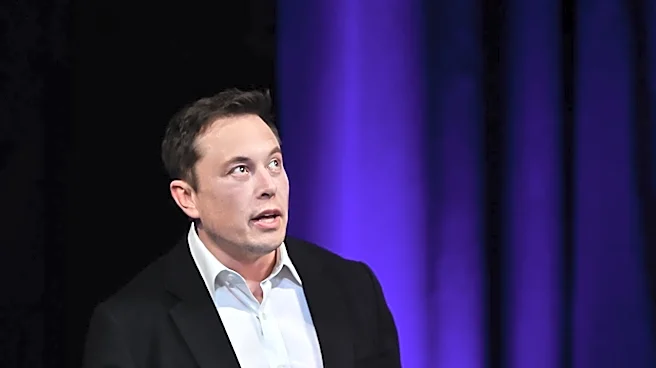
and the current market is a bubble. The other view posits that the present moment is a prime buying opportunity. Chollet presented several data points supporting the latter: GPU spot prices are still rising, compute resources are difficult to secure, HBM and DRAM production capacity until 2029 is largely booked, with memory chip supply expected to remain tight until the 2030s. Additionally, cutting-edge model training compute doubles approximately every five months, and AI inference business profit margins can reach 70% to 85%. In response to Chollet's post, Tesla CEO Elon Musk commented that powering, cooling, and stably operating such large-scale compute clusters is "extremely difficult." Musk warned that the AI industry could face a severe capital shortage next year. He estimated that if the industry-wide cycle from compute cost input to stable revenue generation from equipment is delayed by several months, operational capital alone could require hundreds of billions of dollars in additional investment.
Why It's Important?
Elon Musk's warning about a potential severe capital shortage in the AI industry highlights significant financial and operational challenges facing the sector. This perspective contrasts with the optimistic outlook of continuous growth and investment, suggesting that the rapid expansion of AI infrastructure may outpace the financial and logistical capabilities to sustain it. A capital crunch could lead to a slowdown in AI development, particularly for smaller companies or those heavily reliant on external funding. It also underscores the immense costs associated with scaling AI operations, including not just hardware but also the energy and cooling infrastructure required. This could consolidate power among larger, more financially robust tech giants capable of weathering such a shortage, potentially stifling innovation from emerging players. The debate between Chollet's data-driven optimism and Musk's cautionary note reflects a critical juncture for investors and stakeholders in the AI ecosystem, forcing a re-evaluation of the industry's sustainability and growth trajectory.
What's Next?
The AI industry will likely face increased scrutiny regarding its financial models and infrastructure scalability in the coming year. Companies involved in AI development and infrastructure, particularly those reliant on significant capital expenditure for compute clusters, may need to reassess their funding strategies and operational timelines. Investors might become more cautious, demanding clearer pathways to profitability and more robust financial planning from AI ventures. There could be a push for more efficient energy solutions and cooling technologies to mitigate operational costs, which Musk highlighted as "extremely difficult." Furthermore, the demand for specialized memory chips like HBM and DRAM is projected to remain high, indicating continued supply chain pressures and potentially higher costs for AI hardware. The industry may also see a consolidation trend as smaller entities struggle to secure the necessary capital, leading to acquisitions by larger tech firms. The dialogue initiated by Chollet and Musk will likely fuel further discussions and analyses on the long-term economic viability and infrastructure requirements of the rapidly evolving AI landscape.
Beyond the Headlines
The discussion around AI infrastructure and potential capital shortages extends beyond immediate financial concerns, touching upon broader implications for technological sovereignty and global economic competition. If the U.S. AI industry faces significant capital constraints, it could impact its leadership position in artificial intelligence development, potentially allowing other nations with more robust funding or different economic models to gain ground. The immense energy demands of AI compute clusters also raise environmental concerns, pushing for innovations in sustainable computing and renewable energy integration. Furthermore, the concentration of AI capabilities due to financial barriers could lead to ethical dilemmas regarding access, control, and the equitable distribution of AI's benefits. A capital shortage might also force a re-evaluation of AI's real-world applications, shifting focus from purely speculative ventures to those with clear, immediate economic returns. This could inadvertently accelerate the deployment of practical AI solutions while slowing down more ambitious, long-term research projects, thereby shaping the future trajectory of AI innovation.