








What's Happening?
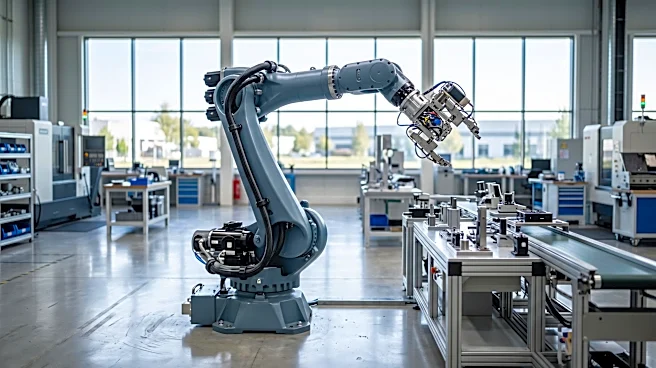
Formic, a Chicago-based company that provides Robot-as-a-Service to American factories, has raised $50 million in a Series B funding round combined with debt financing. This investment will enable Formic to transition its robots from single-task operations
to more versatile, general-purpose machines capable of handling a wider array of factory work. Currently, Formic's robots are deployed in over 100 facilities across more than 30 states, performing tasks such as palletizing, case packing, machine tending, and kit assembly for various industries including food, packaging, chemicals, aerospace, and defense. The company, founded in 2020, offers a monthly fee model that includes robots, software, maintenance, and financing, aiming to remove the upfront cost barrier for manufacturers.
Why It's Important?
This funding is crucial for accelerating the adoption of automation in U.S. manufacturing, addressing challenges such as labor shortages and the need for increased efficiency. By developing general-purpose robots, Formic aims to make automation more accessible and adaptable for a broader range of factory tasks, potentially boosting productivity and competitiveness for American industries. The Robot-as-a-Service model lowers the financial entry barrier for businesses, allowing them to leverage advanced robotics without significant capital expenditure. This shift could particularly benefit small and medium-sized manufacturers, enabling them to automate processes that were previously cost-prohibitive. The expansion into metal fabrication, aerospace, space, defense, medical, and energy sectors signifies a broader impact on critical U.S. industries, enhancing their operational capabilities and potentially fostering innovation.
What's Next?
Formic plans to collaborate with Physical Intelligence to adapt its robot foundation models for factory applications, utilizing Formic's extensive production data. This partnership aims to develop robots that can learn and perform multiple tasks, moving beyond specialized functions. The company is also expanding its operations, with a new assembly and testing site in Bolingbrook, Illinois, and research facilities in Oakland, California. Formic's goal is to further reduce the time it takes to deploy robots into production. The success of this initiative could lead to a significant transformation in U.S. manufacturing, with more factories adopting flexible, automated solutions. The company's growth will also contribute to the ongoing debate about the impact of automation on the workforce and the future of industrial labor.
Beyond the Headlines
The rise of general-purpose factory robots, facilitated by companies like Formic, has profound implications for the future of work and the U.S. economy. While automation promises increased efficiency and productivity, it also raises concerns about job displacement and the need for workforce retraining. The 'Robot-as-a-Service' model democratizes access to advanced robotics, potentially leveling the playing field for smaller businesses but also intensifying competition. This development highlights the ongoing 'physical AI boom,' where the value lies not just in building intelligent machines but in effectively deploying and managing them in real-world industrial settings. The ethical considerations around human-robot collaboration, the safety of automated environments, and the equitable distribution of economic benefits from increased automation will become increasingly important as these technologies become more pervasive in American factories.