





What's Happening?
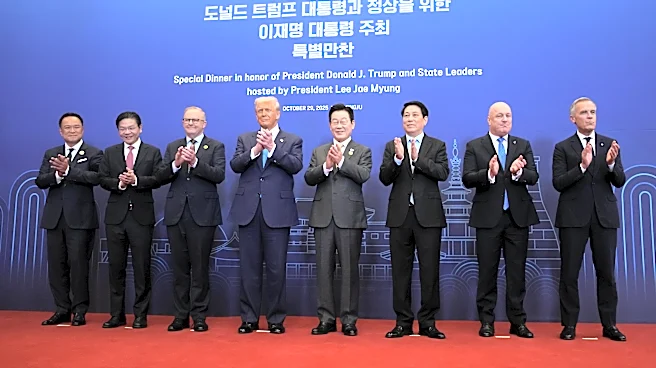
The Asia-Pacific Economic Cooperation (APEC) is set to hold its 33rd Economic Leaders’ Meeting in Shenzhen, China, with a central theme of 'Building an Asia-Pacific Community to Prosper Together.' This meeting follows the 32nd APEC Economic Leaders’ Meeting in Gyeongju,
South Korea, where President Xi Jinping advocated for enhanced regional cooperation in trade, connectivity, the digital economy, and artificial intelligence. The upcoming summit aims to encourage broader AI adoption, improve digital connectivity, foster skills development, and promote cooperation on standards. Initiatives such as the APEC AI Initiative (2026–2030) and the 2026 APEC Digital and AI Ministerial Meeting in Chengdu underscore APEC's commitment to these areas. The focus is on how AI can be applied across various industries to drive productivity gains, rather than solely on its production. This includes exploring new forms of cooperation between China and other economies, particularly in advanced manufacturing and technological innovation.
Why It's Important?
The emphasis on digital economy and AI cooperation at the APEC meeting is crucial for the U.S. and global economic landscape. The rapid advancement of AI presents both opportunities and challenges, and the discussions within APEC could shape international standards and policies for data governance and technological security. For U.S. businesses, particularly those with operations or supply chains in the Asia-Pacific, APEC's efforts to maintain predictable trade and supply-chain connections are vital. The potential for wider AI adoption across industries, from manufacturing to financial services, could lead to significant productivity gains and reshape global competitiveness. If APEC succeeds in fostering cooperation, it could prevent AI capabilities from being concentrated among a few leading companies or economies, ensuring a more equitable distribution of technological benefits. The evolving relationship between China and other economies, driven by China's growing technological prowess, will also impact U.S. strategic and economic interests in the region.
What's Next?
The 33rd APEC Economic Leaders’ Meeting is expected to yield concrete steps towards encouraging wider AI adoption. This includes potential agreements or frameworks for better digital connectivity, skills development programs, and collaborative efforts on establishing AI standards. The meeting will also provide a platform to explore new avenues of cooperation between China and other APEC economies, particularly in areas where Chinese companies are becoming increasingly competitive, such as electric vehicles, renewable energy, robotics, and AI. While a comprehensive agreement on a Free Trade Area of the Asia-Pacific (FTAAP) is not anticipated from this single meeting, proposals for APEC on FTAAP and regional connectivity will be discussed. The outcomes of these discussions could influence future trade policies, investment flows, and technological partnerships across the Asia-Pacific region, impacting how U.S. companies operate and compete.
Beyond the Headlines
The APEC discussions on AI and the digital economy extend beyond immediate economic gains, touching upon deeper implications for global governance and technological ethics. The challenge of ensuring AI does not become a capability exclusive to a select few economies raises questions about digital equity and access. The varying approaches to data governance and technological security among APEC members highlight the complex ethical and legal considerations surrounding AI development and deployment. The shift in China's role from a manufacturing base to a technological innovator also signals a long-term reconfiguration of global economic relationships, potentially leading to new models of international collaboration and competition. This evolution could necessitate a re-evaluation of existing international frameworks and foster new dialogues on how to manage the societal and economic transformations brought about by advanced technologies.