








What's Happening?
Former Finance Secretary Subhash Garg has drawn attention to a significant divergence in India's economic performance: while its real GDP growth is among the highest globally, its growth in current U.S. dollar terms is considerably lower. According to Garg,
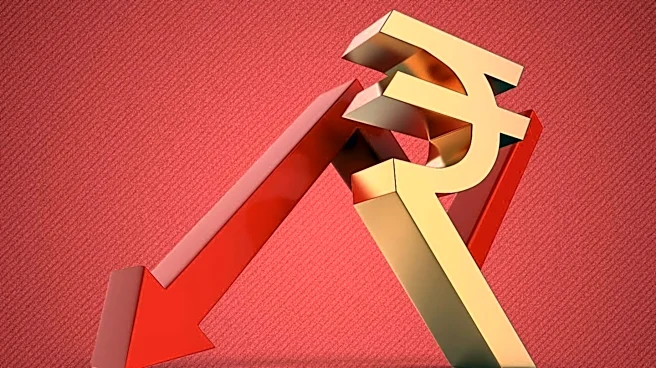
India's GDP is projected to grow by only around 3.5% to 3.6% in current U.S. dollar terms for 2026–27, compared to a global average exceeding 8% and China's growth of over 9%. This discrepancy is primarily attributed to the persistent depreciation of the Indian rupee against the U.S. dollar, which has been under significant pressure since 2023–24. Garg points out that India faces a vulnerable position in foreign exchange and currency management, with a persistent merchandise trade deficit and lukewarm foreign direct investment (FDI) and foreign portfolio investment (FPI) inflows, including substantial FPI withdrawals.
Why It's Important?
This analysis by Subhash Garg is crucial for understanding the true economic health of India and its implications for global investors and trade partners, including the U.S. While high real GDP growth figures might suggest a robust economy, a low dollar GDP growth rate indicates that the benefits of this growth are being significantly eroded by currency depreciation. For U.S. businesses looking to invest in or trade with India, the weakening rupee means that their investments or earnings, when converted back to dollars, yield less. This situation can deter foreign investment and make Indian exports less competitive in dollar terms, despite domestic growth. It also highlights India's vulnerability to global economic challenges, such as oil price fluctuations and geopolitical conflicts, which can exacerbate currency pressures and impact international trade dynamics.
What's Next?
India's Reserve Bank of India (RBI) will likely continue to face pressure to manage the rupee's depreciation, potentially through measures like currency swaps or interventions in the foreign exchange market. The government will need to address the underlying issues contributing to the trade deficit and attract more stable foreign investment. For international investors, particularly those in the U.S., a careful assessment of India's currency risks will be essential when considering market entry or expansion. The ongoing economic policies and their effectiveness in stabilizing the rupee will determine India's attractiveness as an investment destination and its role in the global economy. The situation may also prompt a re-evaluation of how economic growth is measured and communicated, emphasizing the importance of dollar-denominated metrics for international comparisons.
Beyond the Headlines
The disparity between India's real GDP growth and its dollar GDP growth reveals a deeper structural challenge within the economy. It suggests that while domestic production may be increasing, the value generated is not translating effectively into international purchasing power or wealth accumulation in global terms. This can have long-term implications for India's aspirations on the world stage, affecting its ability to fund imports, attract high-quality foreign talent, and project economic influence. The reliance on measures like currency swaps and the withdrawal of FPIs also point to a potential crisis of confidence among international market participants regarding India's currency management. Addressing these issues requires not just economic reforms but also a restoration of trust in the stability and predictability of India's financial policies, which is a complex and multifaceted challenge.