




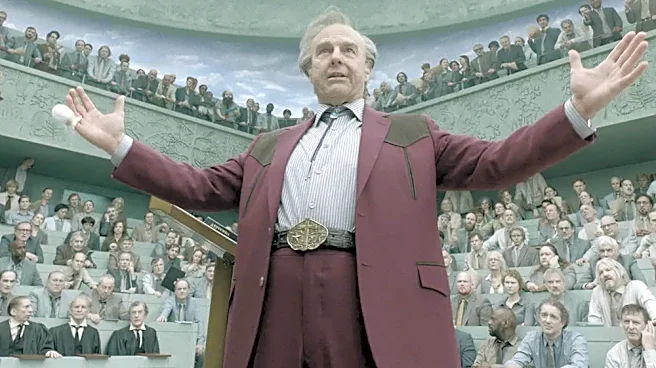

What's Happening?
Christian Bale's career is marked by a wide range of performances and significant physical transformations for his roles. From his early start as a child actor in Steven Spielberg's 'Empire of the Sun' in 1987, Bale has evolved into a performer known
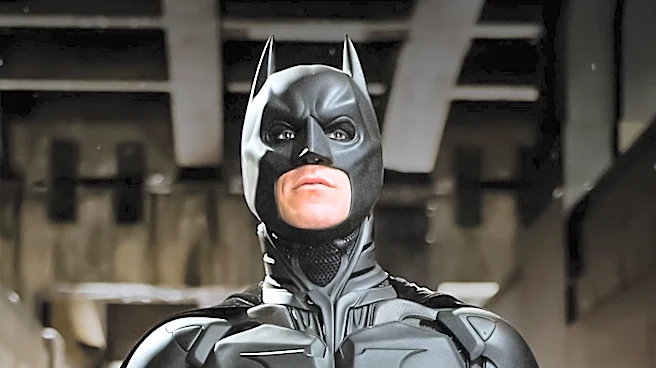
for his meticulous approach to character. His filmography includes pivotal roles such as Patrick Bateman in 'American Psycho' (2000), where he portrayed a psychopathic investment banker, and Trevor Reznik in 'The Machinist' (2004), for which he lost 63 pounds to depict a character suffering from severe insomnia. He also famously took on the role of Batman in Christopher Nolan's 'The Dark Knight Trilogy' (2005-2012), bringing a grounded realism to the character. Bale's commitment to his roles extends to gaining 100 pounds for his Oscar-winning performance as Dicky Eklund in 'The Fighter' (2010) and undergoing extensive physical changes to play former Vice President Dick Cheney in 'Vice' (2018). His recent work includes 'Ford v Ferrari' (2019) and 'Thor: Love and Thunder' (2022), demonstrating his continued versatility across genres.
Why It's Important?
Christian Bale's consistent dedication to transforming for his roles has significantly influenced the acting industry, setting a high bar for method acting and physical commitment. His ability to completely disappear into characters, whether through drastic weight changes or adopting distinct mannerisms, has earned him critical acclaim and multiple awards, including an Academy Award for Best Supporting Actor. This approach not only elevates the quality of his performances but also challenges conventional perceptions of celebrity, as he often becomes unrecognizable in his roles. His film choices, spanning from independent psychological thrillers to major blockbuster franchises, highlight a strategic career path that balances artistic integrity with commercial success. This versatility allows him to appeal to a broad audience while maintaining a reputation as a serious dramatic actor, influencing how actors approach character development and physical embodiment in cinema.
What's Next?
While the source does not explicitly detail Christian Bale's immediate future projects, his established pattern suggests a continued pursuit of diverse and challenging roles. Given his history of significant physical and emotional transformations, it is likely he will continue to seek out characters that demand such dedication. His recent involvement in both critically acclaimed dramas like 'Ford v Ferrari' and major franchise films like 'Thor: Love and Thunder' indicates a continued balance between artistic projects and commercial ventures. Audiences can anticipate further collaborations with acclaimed directors and potentially more roles that push the boundaries of physical and psychological portrayal. His consistent ability to reinvent himself ensures that his future work will likely remain a subject of interest for both critics and the general public, eager to see his next transformation.
Beyond the Headlines
Christian Bale's career trajectory offers a deeper insight into the evolving demands of modern acting and the psychological toll of method acting. His extreme physical transformations, while lauded, also raise questions about the long-term health implications for actors who repeatedly undergo such drastic changes. This commitment to character often blurs the lines between the actor and the role, leading to intense and memorable performances but also potentially impacting personal well-being. Furthermore, Bale's choice of roles, particularly those that delve into the darker aspects of the human psyche like 'American Psycho' or 'The Machinist,' reflects a broader cultural fascination with complex and often morally ambiguous characters. His work contributes to a cinematic landscape that values authenticity and immersive storytelling, pushing the boundaries of what audiences expect from a performance and influencing aspiring actors to commit fully to their craft.