






What's Happening?
The agricultural trailer market, valued at USD 32.75 billion in 2026, is projected to grow to USD 44.70 billion by 2032, exhibiting a Compound Annual Growth Rate (CAGR) of 5.33% from 2027 to 2032. This growth is primarily driven by increasing demand for
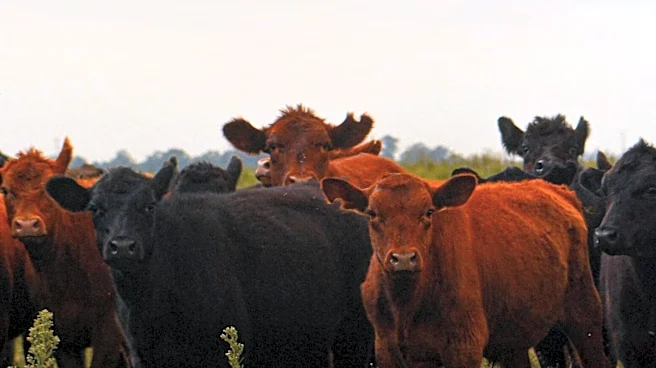
equipment that can handle larger material volumes in fewer trips, a necessity stemming from larger farm sizes and shorter harvest windows. Tipping trailers held the largest market share in 2026 at 40.9%, favored for their efficiency in transporting bulk agricultural materials. Flatbed trailers are anticipated to be the fastest-growing segment, with a projected CAGR of 7.3% from 2027 to 2032, driven by the need to transport machinery and oversized implements. Livestock transportation is also expected to see significant growth, with a CAGR of 6.4% from 2027 to 2032, supported by consolidation in beef, pork, and poultry supply chains.
Why It's Important?
This market expansion is crucial for the U.S. agricultural sector, as it reflects a broader trend towards mechanization and efficiency in farming operations. The demand for higher-capacity and specialized trailers directly addresses challenges such as labor shortages and the need to optimize harvest throughput. For U.S. farmers, investing in advanced agricultural trailers can lead to reduced operational costs, improved productivity, and better management of seasonal demands. The growth in livestock transportation also signifies evolving logistics within the animal agriculture industry, requiring trailers that meet stringent animal welfare and ventilation standards. Manufacturers and technology providers in the U.S. stand to benefit from this increased demand, fostering innovation in trailer design, automation, and connectivity, which can further enhance farm efficiency and profitability.
What's Next?
The agricultural trailer market is expected to continue its growth trajectory, with manufacturers focusing on developing more efficient, higher-capacity, and technologically integrated solutions. The increasing adoption of connected trailers, which facilitate data exchange for optimized loading and unloading, will likely become a standard feature. Future developments will also include innovations in hydraulic push-off systems, self-loading bale platforms, and automated unloading mechanisms to further reduce manual labor requirements. Regulatory frameworks, particularly concerning road weight limits and dimensional restrictions, will continue to influence trailer design and adoption. The market will also see continued consolidation among larger farms and contractor fleets, driving demand for multi-axle trailers capable of handling heavier payloads and reducing transport costs per ton.
Beyond the Headlines
The growth in the agricultural trailer market is indicative of a fundamental shift in how U.S. agriculture operates, moving towards more industrialized and technologically advanced practices. This trend has implications beyond mere equipment sales, affecting labor markets, environmental sustainability, and the overall economic structure of rural communities. The emphasis on efficiency and reduced labor input, while beneficial for productivity, could further reduce the need for manual farm labor, impacting employment opportunities. Furthermore, the development of specialized trailers for livestock and crop transportation highlights the increasing complexity and specialization within agricultural supply chains. The integration of telematics and data exchange capabilities in trailers points towards a future where agricultural machinery is part of a larger, interconnected farm management system, potentially leading to more precise and sustainable farming practices.