




What's Happening?
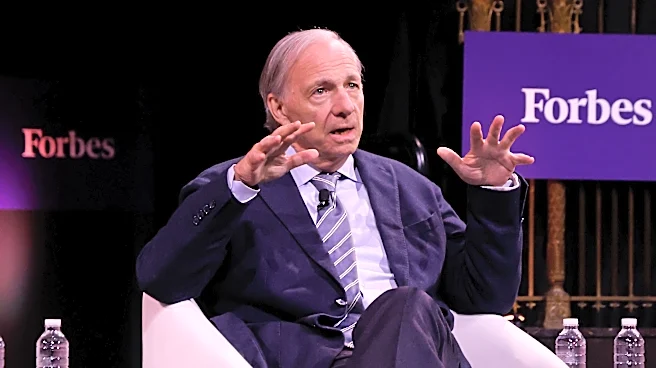
Bridgewater Associates, the investment firm founded by Ray Dalio, has assessed a one-in-three probability of an AI-driven cyberattack causing significant destabilization to the U.S. economy within the next year. This projection comes amidst a recent series
of major tech outages, including disruptions to Microsoft services, a national ground stop for commercial airline traffic by the Federal Aviation Administration, and issues with JP Morgan Chase's transaction processing. While these recent outages have not been definitively linked to malicious actors or a single cause, Bridgewater analysts Hudson Attar and Arham Habib emphasized the importance of preparing for future disruptions. The firm's November 13 note highlighted that AI cyber risks and the cyber-hacking capabilities enabled by open-source models have reached dangerous levels, prompting Bridgewater to implement contingency plans for a potential financial meltdown. They expressed concern over the limited insight decision-makers have into ongoing outages and the rapid growth of AI-enabled cyber warfare.
Why It's Important?
This assessment from a prominent Wall Street asset management firm underscores a growing concern about the vulnerability of critical U.S. infrastructure and financial systems to advanced cyber threats. A destabilizing AI cyberattack could have far-reaching consequences, impacting essential services, financial markets, and the overall economic stability of the nation. Such an event could lead to widespread disruptions in communication, transportation, and banking, affecting millions of Americans and potentially triggering a financial meltdown. The firm's decision to manage money based on this one-in-three chance indicates a serious perceived risk, suggesting that businesses and government agencies may need to significantly re-evaluate and enhance their cybersecurity measures. The potential for AI to amplify cyber warfare capabilities means that traditional defense strategies might be insufficient, necessitating innovative approaches to protect national security and economic interests.
What's Next?
In response to these escalating threats, several nations, including Japan and South Korea, are already enacting legislation to bolster their cyber defenses. The U.S. government and private sector will likely face increased pressure to follow suit, potentially leading to new regulations, increased investment in cybersecurity infrastructure, and enhanced collaboration between public and private entities. Businesses, particularly those in critical sectors like finance, technology, and transportation, may need to review and update their contingency plans to account for AI-driven cyber risks. The ongoing development of AI technologies, particularly open-source models, will require continuous monitoring and adaptation of security protocols to mitigate emerging threats. The financial markets may also see shifts as investors, like Bridgewater Associates, adjust their strategies to account for the potential economic impact of such cyber events.
Beyond the Headlines
The concerns raised by Bridgewater Associates highlight a critical ethical and societal challenge associated with the rapid advancement of artificial intelligence. The dual-use nature of AI, where technologies developed for beneficial purposes can also be weaponized, presents a complex dilemma for policymakers and developers. The exponential growth of AI-enabled cyber warfare capabilities could lead to a new era of digital conflict, blurring the lines between state-sponsored attacks and non-state actor threats. This situation also raises questions about international cooperation in regulating AI and cyber warfare, as a globalized digital infrastructure means that a cyberattack originating anywhere can have worldwide repercussions. The need for robust ethical frameworks and international agreements on the responsible development and deployment of AI will become increasingly paramount to prevent catastrophic outcomes.