




What's Happening?
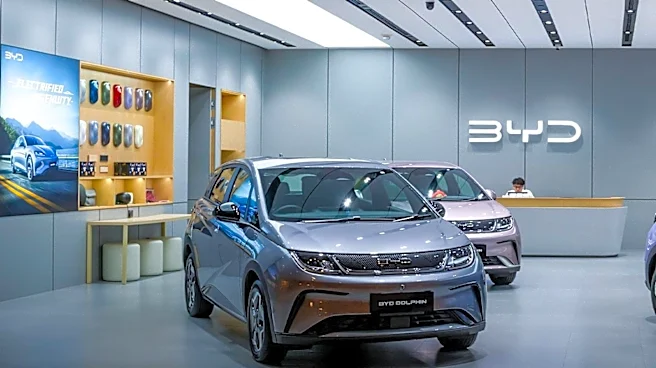
BYD has filed a patent for a new solid-state battery design that incorporates a dual-electrolyte cathode structure. This design uses smaller-particle halide electrolytes and larger-particle sulfide electrolytes combined with the cathode active material
to form a composite electrode structure. The patent, published by the China National Intellectual Property Administration, addresses the challenge of maintaining stable contact between solid materials during repeated charging and discharging cycles. While the patent provides insight into BYD's research direction, it does not confirm production plans or vehicle applications. The development is part of BYD's broader research into solid-state battery materials, which are seen as a future technology for electric vehicles due to their potential for higher energy density and safety.
Why It's Important?
The advancement in solid-state battery technology is significant for the electric vehicle industry, as it promises to overcome current limitations of lithium-ion batteries, such as safety risks and limited energy density. BYD's research into dual-electrolyte systems could lead to more efficient and durable batteries, potentially reducing costs and increasing the range of electric vehicles. However, the technology is still in the research phase, and large-scale adoption faces challenges related to manufacturing and technical hurdles. Successful development and commercialization of solid-state batteries could position BYD as a leader in the next generation of battery technology, impacting global automotive markets and accelerating the transition to electric vehicles.