





What's Happening?
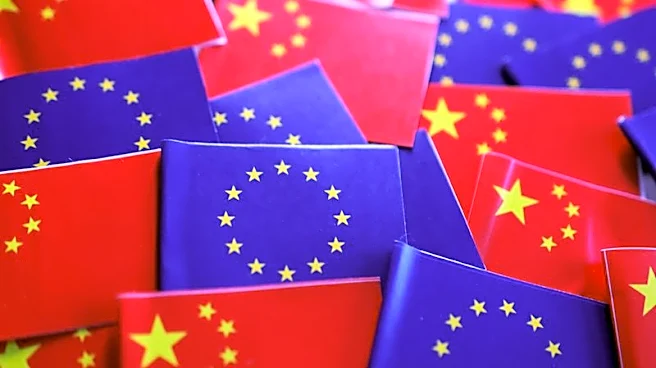
China and the European Union concluded two days of trade talks in Beijing on October 9, resulting in a package of 'shared understandings' on hybrid cars, rare earths, and trade balance. The meeting, co-chaired by Chinese Commerce Minister Wang Wentao
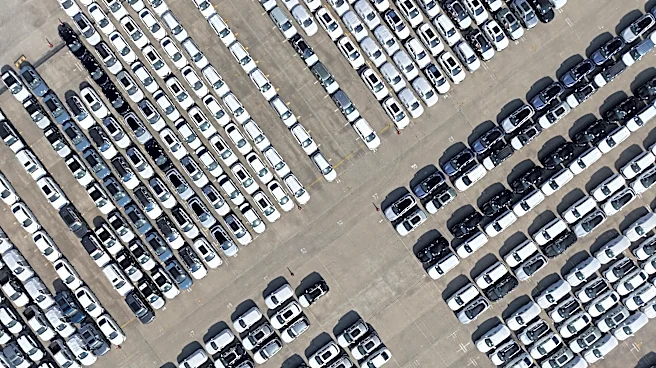
and EU Trade Commissioner Maroš Šefčovič, was the second session of their trade and investment consultation mechanism. Key outcomes include an understanding on hybrid vehicle trade, which EU officials interpret as halving exports of hybrid and plug-in hybrid vehicles to the EU, and a continued commitment from China to facilitate export license approvals for rare earths and permanent magnets bound for the EU through a 'green channel.' The talks aimed to address rising friction over the EU's trade deficit with China and new trade defense measures, easing fears of a full-blown trade war, though tensions remain.
Why It's Important?
This agreement is significant as it represents a step towards de-escalating trade tensions between two major global economic powers. For the EU, the understanding on hybrid vehicles could help rebalance trade and protect its automotive industry from what it perceives as an overwhelming influx of Chinese imports. The commitment on rare earths is crucial for European green technology, defense, and automotive industries, which rely heavily on these materials. For China, the agreement provides a framework for managing trade disputes within WTO rules and maintaining a regular dialogue schedule, which is vital for its export-oriented economy. The talks highlight the complex interdependence between China and the EU, where economic cooperation is intertwined with strategic competition. The outcome could influence global trade policies and encourage other nations to adopt similar mechanisms for resolving trade imbalances.
What's Next?
Several details of the agreement, particularly regarding the hybrid vehicle understanding, remain to be clarified, including the baseline, quota mechanisms, and enforcement. EU leaders will discuss the package at the European Council on October 15 and 16, with Brussels' approval still required for the final decision. A ministerial video conference between China and the EU is planned for January, and the third meeting of the consultation mechanism is scheduled for March 2027. These upcoming discussions will be critical in translating the 'shared understandings' into concrete measures. Businesses, especially in the automotive and rare earth-dependent sectors, will need to closely monitor these developments for specific implementation details that could impact their operations, supply chains, and market strategies. The ongoing battery-electric vehicle dispute will also continue on a separate track.
Beyond the Headlines
The differing interpretations of the hybrid vehicle agreement by EU and Chinese officials underscore the inherent challenges in international trade negotiations, where both sides often present outcomes in a light favorable to their domestic audiences. This situation could lead to further friction if the practical implementation does not align with expectations. The focus on rare earths also highlights the strategic importance of critical minerals in the global economy and the ongoing efforts by nations to secure their supply chains. This agreement, while easing immediate tensions, does not resolve the underlying structural issues contributing to trade imbalances. It suggests a future where trade relations are increasingly managed through a series of specific, sector-by-sector agreements rather than broad free trade pacts, reflecting a more fragmented and protectionist global trade landscape. The long-term implications could include a shift towards greater regionalization of supply chains and increased investment in domestic production capabilities for strategically important goods.