





What's Happening?
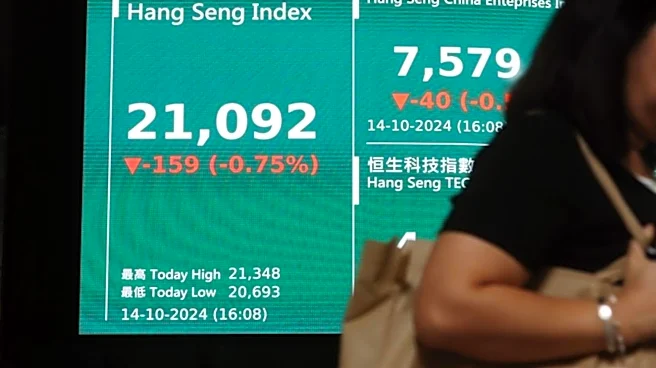
Hong Kong and mainland Chinese stock markets experienced declines, with the Hang Seng Index falling 1.3% and the Hang Seng Tech Index dropping 1.8%. This downturn was largely attributed to a sharp selloff in U.S. technology shares, which spilled over
into Asian trading hours, raising investor concerns about the fading momentum in the artificial intelligence (AI) trade. Despite the daily drops, the Hang Seng Index gained 5.1% for the week, and the Hang Seng Tech Index rose 8.6%, marking their largest weekly advances since March 2025 and February 2025, respectively. In mainland China, the STAR 50 Index and the CSI Artificial Intelligence Index pared losses after falling as much as 5.2% intraday. The steepest declines were observed in AI-related hardware stocks with significant revenue exposure to the U.S. market, such as China's Zhongji Innolight and Eoptolink Technology. The mainland market's resilience was bolstered by government-backed funds, known as the 'national team,' which reportedly poured approximately CNY 170 billion (about $25.5 billion) into exchange-traded funds (ETFs) to support the market.
Why It's Important?
The volatility in Hong Kong and mainland Chinese stock markets, influenced by U.S. AI sector performance, highlights the interconnectedness of global financial markets. For U.S. investors and businesses, this demonstrates how shifts in U.S. tech sentiment can rapidly impact Asian markets, particularly in the burgeoning AI sector. The significant weekly gains in Hong Kong's tech index, despite daily drops, suggest underlying investor confidence in the long-term potential of AI and technology in the region, even amidst short-term fluctuations. The intervention by China's 'national team' to support its markets underscores the government's commitment to maintaining financial stability and preventing systemic risk, which can influence investor behavior and market dynamics. This government intervention also indicates a potential divergence in market mechanisms, where state-backed support can cushion downturns, a factor U.S. investors must consider when evaluating risks and opportunities in Chinese markets. The performance of AI-related hardware stocks with U.S. revenue exposure also points to the sensitivity of these companies to U.S. market conditions and trade relations.
What's Next?
The ongoing interplay between U.S. tech market sentiment and Asian stock performance is likely to continue, requiring investors to closely monitor global economic indicators. China's government is expected to maintain its market support measures to ensure stability, especially in critical sectors like AI and technology. This could lead to a more managed market environment in mainland China compared to the more free-floating Hong Kong market. Companies with significant revenue exposure to the U.S. market, particularly in AI hardware, may face continued pressure if U.S. tech sentiment remains volatile. Conversely, China's push for technological self-reliance, as noted by Dillin Wu, a strategist at Pepperstone, suggests that domestic AI chip companies like Huawei Technologies and Cambricon may see growth driven by internal policies, potentially creating distinct investment opportunities. Investors will need to differentiate between companies primarily serving the domestic Chinese market and those with international exposure when assessing future performance.
Beyond the Headlines
The market dynamics observed in Hong Kong and China reflect a deeper geopolitical and economic competition, particularly in the technology and AI sectors. The 'spillover' effect from U.S. tech selloffs into Asian markets underscores the global nature of capital flows and investor sentiment, but China's government intervention highlights a strategic effort to insulate its economy from external shocks. This could lead to a more bifurcated global tech market, where U.S. and Chinese tech ecosystems develop with increasing independence, driven by national security and economic self-reliance objectives. The emphasis on AI governance and data risk management, as indicated by related discussions on HKEX listing requirements, points to a growing regulatory landscape that will shape how technology companies operate and are valued. For U.S. businesses, this implies a need for nuanced strategies that account for both global market interconnectedness and the distinct regulatory and political environments in China and Hong Kong, particularly concerning data privacy, cybersecurity, and intellectual property.