








What's Happening?
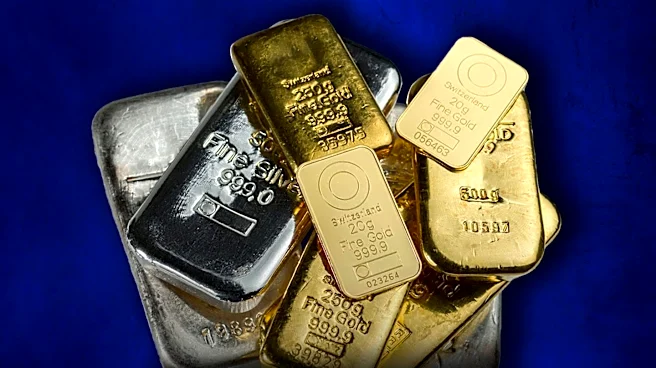
Schroders, a global investment management firm, has released an analysis indicating that central bank gold demand is expected to remain strong, driven by a split in market behavior between Eastern and Western investors. According to Schroders, Eastern central banks,
particularly in emerging markets, are capitalizing on lower gold prices to increase their reserves, while Western investors are reducing their holdings due to perceived hawkish policies by the Federal Reserve. The analysis highlights that Poland has been a significant buyer of gold since Russia's invasion of Ukraine in 2022, and it is expected to continue purchasing even after reaching its target of 700 tonnes. China's People's Bank of China (PBOC) is also noted as a major buyer, with its purchases having a significant signaling effect on domestic and potentially other central banks' demand.
Why It's Important?
The ongoing demand for gold by central banks, particularly in Eastern markets, underscores a strategic shift in reserve management amid geopolitical tensions and economic uncertainties. This trend could have long-term implications for global gold prices and market stability. The divergence in investment strategies between Eastern and Western markets reflects broader economic and political dynamics, including differing responses to inflation and monetary policy. For the U.S., this could mean continued pressure on the dollar and potential impacts on trade balances and economic relations with countries heavily investing in gold. The sustained demand for gold as a reserve asset may also influence global financial markets and investment strategies.
What's Next?
As central banks continue to accumulate gold, the market may see sustained or increased prices, influencing investment strategies globally. The Federal Reserve's future policy decisions, particularly regarding interest rates, will be closely watched as they could impact Western investors' behavior and the broader economic landscape. Additionally, geopolitical developments, such as tensions in Eastern Europe and Asia, could further drive central banks' decisions to diversify reserves into gold. Monitoring these trends will be crucial for investors and policymakers to understand the evolving dynamics of global financial markets.