





What's Happening?
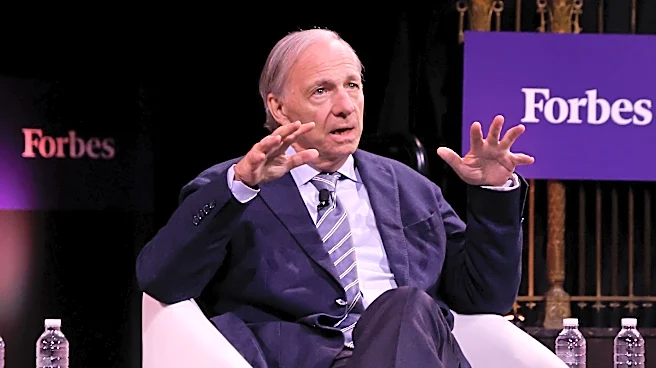
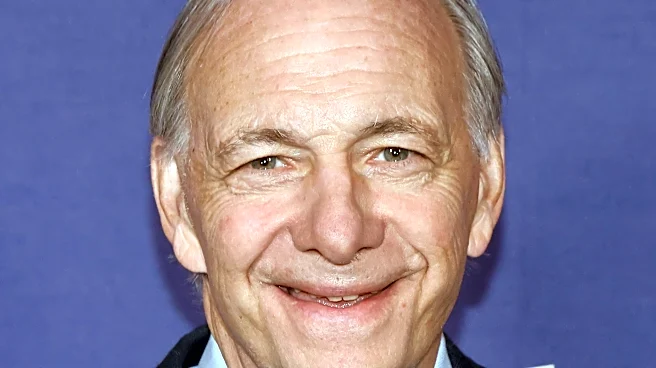
Ray Dalio, founder of Bridgewater Associates, continues to advise investors to allocate 10-15% of their portfolios to gold, despite a recent 28% drop from its January record for SPDR Gold Shares (GLD). Dalio's recommendation is rooted in the belief that
gold acts as insurance against a potential U.S. debt crisis, which he suggests could materialize within the next five years. He argues that gold provides diversification, especially during periods when both stocks and bonds perform poorly, citing its performance in 2008 and 2022. For instance, in 2008, when the S&P 500 fund lost 38.3%, GLD gained 4.9%. Similarly, in 2022, as inflation and rising rates impacted both stocks and bonds, the S&P fund lost 19.5%, while GLD only lost 0.8%. This advice is particularly relevant for retirees, such as a 66-year-old with an $800,000 IRA and $2,800 monthly Social Security, who must decide whether to include gold in their retirement portfolio.
Why It's Important?
Dalio's persistent advocacy for gold highlights a significant concern among some financial experts regarding the stability of the U.S. economy and the potential for a debt crisis. His recommendation underscores a strategy to hedge against systemic risks that could devalue traditional assets like bonds and the U.S. dollar. For individual investors, particularly retirees, this advice presents a dilemma: balance the potential for long-term protection against short-term losses. The recent decline in gold prices tests the conviction behind such a strategy, as holding gold incurs costs, including management fees and foregone interest from other investments like Treasury bills. The debate between Dalio's insurance-based approach and Warren Buffett's view that gold is unproductive assets reflects differing philosophies on wealth preservation and growth, impacting how millions of Americans manage their retirement savings and investment portfolios.
What's Next?
Investors, especially those nearing or in retirement, will likely continue to weigh Dalio's advice against gold's recent performance and other investment opportunities. The ongoing U.S. fiscal situation, including record deficits, will be a critical factor influencing the perceived need for gold as a hedge. Should a U.S. debt crisis materialize as Dalio predicts, the value of gold could significantly appreciate, validating his long-term strategy. Conversely, if the U.S. economy remains stable and traditional assets perform well, the opportunity cost of holding gold will continue to be a point of contention. Retirees, in particular, will need to monitor gold's price movements and the broader economic landscape to determine if a 10-15% allocation aligns with their risk tolerance and financial goals, potentially adjusting their portfolios based on evolving market conditions and expert opinions.
Beyond the Headlines
The discussion around gold as an investment extends beyond mere financial returns; it touches upon fundamental trust in governmental fiscal policies and the stability of fiat currencies. Dalio's emphasis on gold as insurance against a debt crisis reflects a deeper skepticism about the long-term sustainability of current economic practices. This perspective challenges conventional investment wisdom that often prioritizes growth-oriented assets. The ethical dimension arises in how financial advisors guide vulnerable populations, like retirees, through volatile markets, balancing the promise of protection with the reality of potential short-term losses. Culturally, gold has historically been a symbol of wealth and stability, and its resurgence in investment discussions during times of economic uncertainty highlights a return to tangible assets as a safeguard against abstract financial risks, influencing broader societal attitudes towards money and security.