




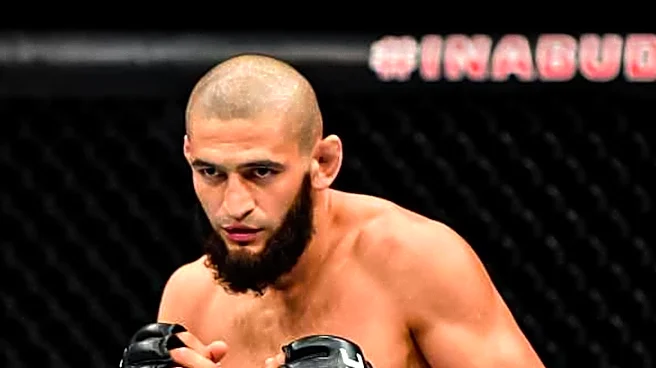

What's Happening?
American fighter Anthony Romero, known as 'The Bully,' made his UFC debut at UFC 332 on October 3, 2026, stepping in on three days' notice to face Marcus McGhee. The fight, contested at Featherweight, a weight class above Romero's natural Bantamweight,
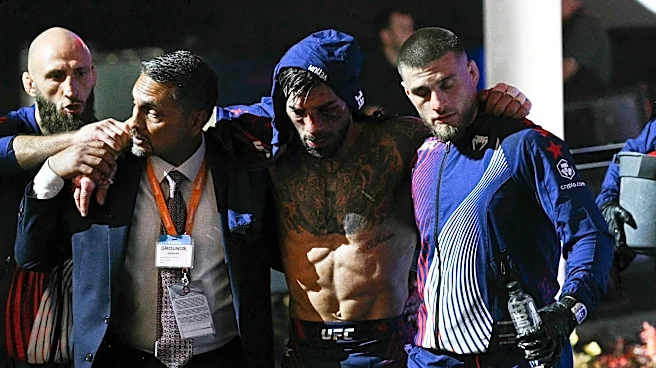
ended in a first-round TKO loss for Romero, just two seconds before the bell. Despite the short notice and weight disadvantage, Romero, who has a professional MMA record of 7-3, showed early aggression, taking the center of the cage and landing significant strikes. However, a jab from McGhee sent him to the canvas, leading to a swarm of ground-and-pound that secured McGhee the victory.
Why It's Important?
Romero's UFC debut, though a loss, highlights the immense challenges and high stakes involved in entering the premier mixed martial arts organization on short notice. His willingness to take the fight at a higher weight class with minimal preparation demonstrates the ambition and resilience common among aspiring UFC fighters. This event underscores the unforgiving nature of professional MMA, where even a moment's lapse can lead to defeat. For Romero, this fight serves as a crucial learning experience, providing exposure to the UFC environment and setting the stage for future opportunities, likely at his natural Bantamweight division with a full training camp. His journey from a regional circuit fighter to the UFC octagon, despite the outcome, is a testament to his dedication.
What's Next?
Following this debut loss, Anthony Romero will likely aim for another UFC fight, ideally with a full training camp and at his preferred Bantamweight division (135 lbs). His performance, despite the TKO, showed flashes of potential, which could earn him another chance in the organization. The experience gained from fighting on such a grand stage will be invaluable for his development. He will need to refine his strategy and defense to compete effectively against top-tier opponents. The focus will be on securing a win in his next outing to establish his position within the UFC roster and prove his capabilities under optimal conditions.
Beyond the Headlines
Romero's story is a microcosm of the broader narrative of many aspiring athletes who dedicate years to their craft, often facing significant personal and financial sacrifices. His background, having started training at ten and working multiple jobs before fighting paid off, illustrates the deep commitment required to pursue a career in professional sports. The 'kid who was supposed to be a statistic' narrative adds a layer of inspiration, showcasing how determination can defy expectations. His journey also sheds light on the often-unseen pressures and rapid turnarounds that can define a fighter's career, where a single opportunity can arise with little warning, demanding immediate readiness and courage.