






What's Happening?
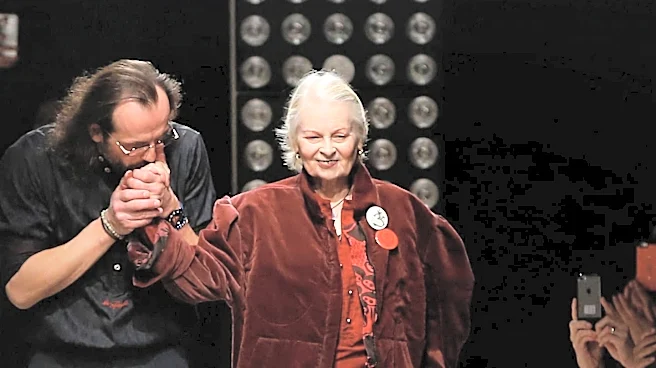
Vivienne Westwood's profound influence on fashion is characterized by her transformation of punk and new wave dress into a mainstream institution. Her career, spanning four decades, evolved from deliberately abrasive designs rooted in fetish imagery,
intended to provoke the comfortable middle class, to a sophisticated design language built on tailoring, corsetry, and historical references. Westwood, alongside Malcolm McLaren, opened various shops on King's Road, starting with 'Let It Rock' in 1971, which continually changed names, including 'Sex' and 'Seditionaries.' These boutiques were central to the punk explosion in London, with the Sex Pistols wearing Westwood's and McLaren's designs, creating a symbiotic relationship between clothing and music. Sky Arts ranked her as the fourth most influential artist in Britain of the past 50 years in 2022, highlighting her unique ability to change fashion's narrative.
Why It's Important?
Vivienne Westwood's legacy is crucial for understanding the evolution of fashion from a purely aesthetic pursuit to a powerful medium for social and political commentary. Her work demonstrated that subculture could not only enter the mainstream but also become an enduring institution without losing its rebellious essence. This shift has had a lasting impact on the fashion industry, encouraging designers to incorporate activism and critical thought into their collections. For U.S. fashion and culture, Westwood's approach validated the idea that clothing can be a form of protest and a reflection of societal tensions. Her influence can be seen in contemporary designers who blend historical elements with modern rebellion, and in the ongoing conversation about the role of fashion in addressing social issues, from climate action to civil rights.
What's Next?
The house of Vivienne Westwood continues under the leadership structure she established with her husband and collaborator, Andreas Kronthaler. Her design principles—such as the corseted waist, off-kilter tailoring, and the reinterpretation of historical elements—are expected to remain central to the brand's identity. These elements are no longer mere trends but have become an inherited grammar within fashion, influencing new generations of designers. The ongoing challenge for the brand, and a broader question for the industry, is whether a house built on dissent can continue to challenge norms as it scales and becomes more institutionalized. The brand's future will likely involve navigating this tension, potentially through continued engagement with social causes and innovative design that honors Westwood's original spirit of provocation and craftsmanship.
Beyond the Headlines
Beyond the immediate impact on fashion trends, Vivienne Westwood's career highlights deeper implications regarding the commercialization of subculture and the role of art in activism. She blurred the lines between designer and activist, integrating causes like nuclear disarmament and climate action into her brand's identity. This approach challenges the traditional separation of politics and product, a tension that many contemporary brands now grapple with. Her working-class background and unconventional entry into fashion also predate current discussions about inclusivity and accessibility within the industry. Westwood's ability to transform a punk archive into a 'museum-grade conversation with the 18th century' demonstrates how historical context can be reinterpreted to maintain relevance and provoke thought, proving that true influence lies in a continuous argument with the past and present, rather than mere replication.