





What's Happening?
Black Bayou Energy Hub, an energy infrastructure company based in Louisiana, has unveiled plans for a $1.6 billion investment to expand its Lafayette headquarters and develop new natural gas infrastructure in Cameron Parish. This significant investment aims
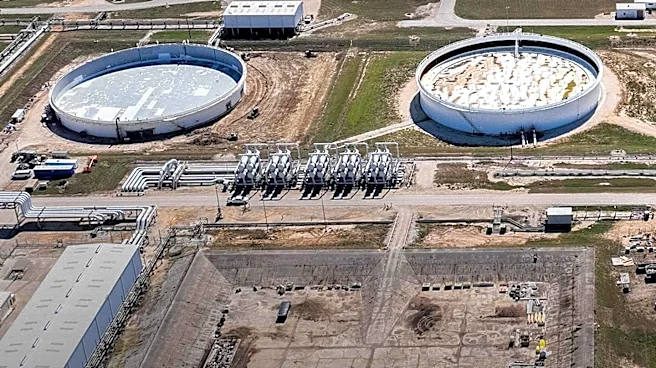
to bolster Louisiana's liquefied natural gas (LNG) corridor, addressing the increasing demand from LNG exports, power generators, manufacturers, and utilities. The new natural gas infrastructure will be centered around the Black Bayou salt dome in Cameron Parish and extend into Calcasieu Parish, providing essential services such as blending, balancing, storage, and transportation for LNG exporters and other entities. Construction for the infrastructure is slated to commence in 2026, with full completion anticipated by 2028. Concurrently, the expansion of the Lafayette headquarters will support the company's long-term administrative, engineering, and operational functions.
Why It's Important?
This $1.6 billion investment by Black Bayou Energy Hub is crucial for strengthening Louisiana's position as a leading hub for LNG production and export in the U.S. The expansion of natural gas infrastructure is vital for supporting the substantial LNG projects already underway in the state, which have seen over $48 billion in announcements since 2024. This development will enhance the state's capacity to meet growing domestic and international energy demands, thereby impacting the U.S. energy market and its global trade relationships. The project is expected to create 23 direct new jobs in Louisiana, contributing to local economic growth. Furthermore, by improving the efficiency and reliability of natural gas supply, it will benefit power generators, manufacturers, and utilities, potentially leading to more stable energy prices and increased industrial activity within the region and across the nation.
What's Next?
Construction of the new natural gas infrastructure in Cameron and Calcasieu Parishes is scheduled to begin in 2026, with an expected completion by 2028. Black Bayou Energy Hub will also proceed with the expansion of its Lafayette headquarters to accommodate its growing administrative and operational needs. The company will focus on integrating the new infrastructure with existing energy networks to optimize blending, balancing, storage, and transportation services. Stakeholders, including state economic development agencies, local communities, and energy industry partners, will closely monitor the project's progress and its impact on the regional economy and energy landscape. The successful implementation of this project could pave the way for further investments in Louisiana's energy sector and reinforce its role in the national energy strategy.
Beyond the Headlines
The Black Bayou Energy Hub's investment highlights a broader trend in the U.S. energy sector: the continued reliance on and expansion of natural gas infrastructure, even amidst a global push for renewable energy. While LNG offers a cleaner alternative to other fossil fuels, its expansion raises questions about long-term environmental impacts and the pace of transition to fully renewable sources. The project's focus on strengthening the LNG corridor underscores the economic and strategic importance of natural gas exports for the U.S., particularly in geopolitical contexts. It also brings to light the complex balance between economic development, energy security, and environmental considerations. The creation of new jobs and the bolstering of local economies are significant, but they also prompt discussions about workforce development in the evolving energy landscape and the potential for community impacts in areas hosting large-scale energy infrastructure.