






What's Happening?
Shopify CEO Tobias Lütke is championing an alternative strategy in the artificial intelligence race, focusing on developing small, specialized AI models rather than competing with companies building large general-purpose models. While major tech firms
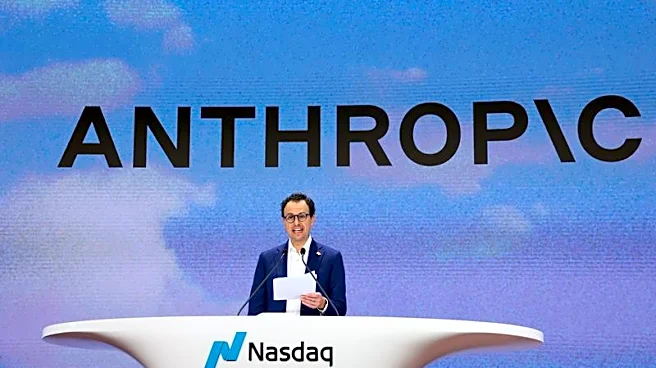
like OpenAI, Google, and Anthropic are investing billions in increasingly powerful frontier models with vast parameters and computing power, Lütke believes this approach can be inefficient for specific business tasks. Shopify's strategy involves training smaller AI models to become exceptionally proficient at particular functions, such as classifying customer requests or generating specific product descriptions. This method aims to create a self-improving AI flywheel where models are continuously refined based on performance evaluation and feedback, leading to better training data and improved model versions. Lütke has also highlighted an internal platform, tangleml.com, built by Shopify to support this development, testing, and improvement of specialized models.
Why It's Important?
Shopify's pivot to specialized AI models could significantly impact the broader AI industry and e-commerce sector. By focusing on smaller, task-specific models, Shopify aims to achieve greater efficiency and cost-effectiveness compared to running large, general-purpose AI models for every operation. This approach could lead to lower computing costs, faster response times, and enhanced control over the AI systems utilized within the company. Furthermore, it reduces Shopify's dependence on external AI providers, offering a strategic advantage in an increasingly AI-driven software landscape. For the e-commerce industry, this could mean more tailored and effective AI solutions for merchants, addressing specific business problems with precision rather than relying on broad AI capabilities. This strategy also underscores the value of domain knowledge, as Shopify leverages its deep understanding of merchant needs to develop AI that is highly relevant and impactful for commerce.
What's Next?
Shopify is expected to continue refining and expanding its use of specialized AI models across its platform. The company's internal platform, tangleml.com, will likely play a crucial role in this ongoing development, facilitating the creation, testing, and improvement of these focused AI solutions. This strategic direction could inspire other companies, particularly those with specific industry needs, to explore similar approaches, potentially leading to a diversification of AI development strategies beyond the current emphasis on large, general-purpose models. The success of Shopify's model could also influence how AI is integrated into various business workflows, emphasizing practical problem-solving and efficiency over raw computational power. Future updates from Shopify may detail the performance and impact of these specialized AI applications on merchant operations and overall platform functionality.
Beyond the Headlines
Shopify's strategy challenges the prevailing narrative in the AI industry that bigger models are inherently better. This shift towards 'going focused' rather than 'going small' highlights a critical re-evaluation of AI's purpose in business—moving from general intelligence to highly effective, task-specific solutions. This approach could foster a new wave of innovation where companies prioritize deep integration of AI into their core operations, leveraging their unique data and domain expertise. Ethically, this could lead to more transparent and controllable AI systems, as their functions are narrowly defined and easier to audit. Legally, reduced reliance on third-party AI providers might simplify compliance and data governance. Culturally, it could shift the perception of AI from a monolithic, all-knowing entity to a collection of specialized tools designed to augment human capabilities in specific contexts, ultimately making AI more accessible and practical for a wider range of businesses.