





What's Happening?
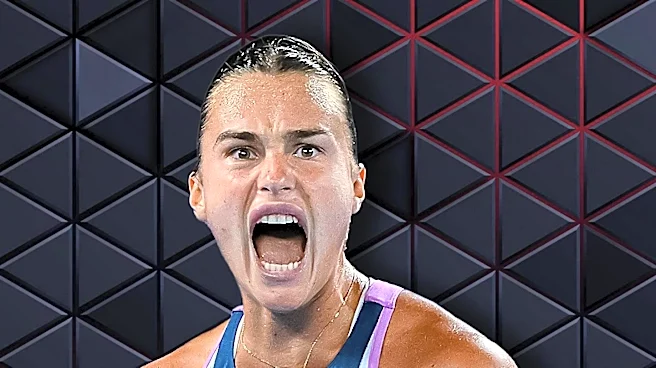
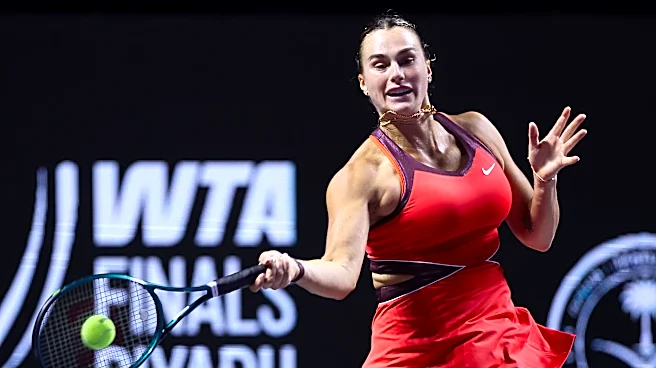
World No. 3 Jessica Pegula has offered a unique perspective on Aryna Sabalenka's on-court mentality, suggesting that the Belarusian player performs optimally when she is angry. This observation challenges the common belief that Sabalenka's emotional displays
hinder her performance, particularly in Grand Slam finals, where she has won only one of five in the past two years. Pegula, who lost to Sabalenka in the US Open semi-finals, stated on The Player’s Box Podcast that Sabalenka's anger fuels her game, allowing her to play exceptionally well, a trait Pegula admits she cannot replicate. Former Australian Open champion Madison Keys echoed this sentiment, suggesting that Sabalenka would not be as successful if she were to suppress her emotions. This perspective contrasts with the typical view that composure is key to success in high-stakes tennis matches.
Why It's Important?
This insight from top players like Pegula and Keys is significant because it re-evaluates the role of emotion in elite sports performance. It suggests that for some athletes, anger or visible frustration can be a powerful motivator and a component of their peak performance, rather than a detriment. This challenges the conventional wisdom that athletes must maintain a calm demeanor to succeed, opening a discussion about individual differences in psychological approaches to competition. For Sabalenka, this perspective could validate her playing style and potentially alleviate pressure to conform to a more stoic image. It also provides fans and analysts with a deeper understanding of the complex mental game at the highest levels of tennis, highlighting that what works for one player may not work for another.
What's Next?
This discussion could influence how Aryna Sabalenka's on-court demeanor is perceived and analyzed by commentators, coaches, and fans. Instead of viewing her emotional outbursts solely as weaknesses, they might be reinterpreted as integral to her competitive edge. Sabalenka herself might embrace this aspect of her game more fully, rather than attempting to suppress it. Other players and coaches might also consider how different emotional states can be harnessed for performance, leading to more individualized mental training strategies in tennis. The ongoing debate about emotional control versus emotional expression in sports is likely to continue, with Sabalenka's career serving as a prominent case study.
Beyond the Headlines
The conversation around Sabalenka's emotional play delves into the broader psychological aspects of competitive sports. It highlights that there isn't a single 'correct' mental approach to achieving success; rather, individual athletes must discover what psychological states best unlock their potential. This perspective can be applied beyond tennis to other high-pressure fields, suggesting that emotional expression, when channeled effectively, can be a source of strength. It also touches on the societal expectation for athletes, particularly women, to maintain composure, and how defying these norms can lead to both criticism and unique competitive advantages. The discussion encourages a more nuanced understanding of athlete psychology, moving beyond simplistic notions of 'good' or 'bad' emotions in performance.