







What's Happening?
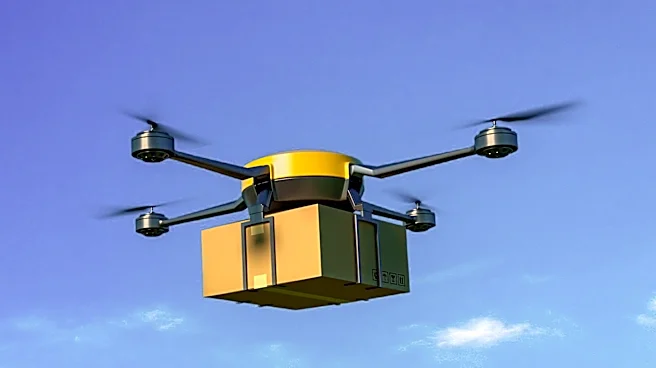
Walmart has announced a significant expansion of its drone delivery services across the United States, entering into a new multiyear agreement with Zipline. This partnership aims to establish 300 new drone delivery sites nationwide, with potential for
further growth. The expansion builds upon Walmart's existing drone delivery program, which has already successfully completed over 2 million deliveries. Walmart and Zipline have been collaborating on drone deliveries since 2021. According to Greg Cathey, senior vice president, eCommerce fulfillment transformation at Walmart, customers initially try drone delivery out of novelty but continue to use it for its convenience when they require items quickly. The company plans to offer tens of thousands of eligible items for delivery in as fast as 30 minutes in areas where the service is available.
Why It's Important?
This nationwide expansion of drone delivery services by Walmart holds significant implications for the U.S. retail industry and consumer expectations. With 90% of Americans living within 10 miles of a Walmart store, the company possesses a unique logistical advantage to scale this technology. The ability to deliver a wide range of products in as little as 30 minutes could fundamentally alter consumer shopping habits, increasing demand for instant gratification and potentially pressuring other retailers to adopt similar rapid delivery solutions. This move could also create new job opportunities in drone operations, maintenance, and logistics. For consumers, it offers unparalleled convenience, especially for urgent needs, while for Walmart, it strengthens its competitive edge in the e-commerce space against rivals by leveraging its extensive physical store footprint as distribution hubs.
What's Next?
The rollout of 300 new drone delivery sites will proceed over the coming years, with Walmart and Zipline focusing on integrating these services into existing store operations and local communities. This expansion will likely involve significant infrastructure development, including drone launch and landing pads at Walmart locations, and the hiring and training of personnel for drone operations. Regulatory bodies, such as the Federal Aviation Administration (FAA), will continue to play a crucial role in overseeing the safe and efficient deployment of these drone networks, potentially leading to further advancements in drone regulations. Other major retailers will be closely observing Walmart's success, which could accelerate the adoption of drone delivery technology across the U.S. retail sector, leading to a more competitive and technologically advanced delivery landscape.
Beyond the Headlines
The widespread adoption of drone delivery by a retail giant like Walmart could trigger deeper societal and economic shifts. Beyond mere convenience, it raises questions about urban planning, noise pollution, and airspace management in residential areas. The ethical implications of increased automation in delivery services, including potential impacts on traditional delivery jobs, will also become more prominent. Furthermore, the data collected from millions of drone deliveries could provide unprecedented insights into consumer behavior and logistical efficiencies, leading to more personalized services and optimized supply chains. This initiative represents a significant step towards a future where autonomous delivery systems are commonplace, potentially reshaping the very fabric of local commerce and daily life in American communities.