


What's Happening?
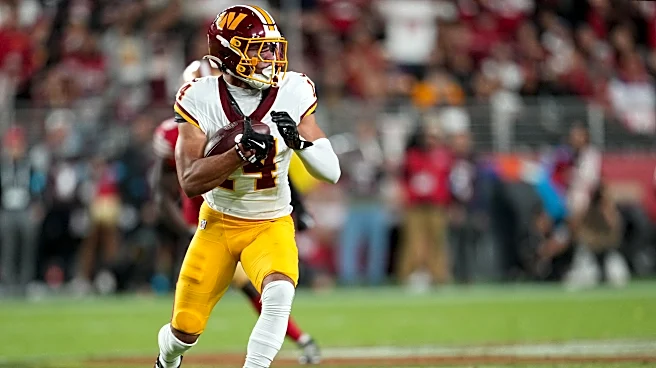
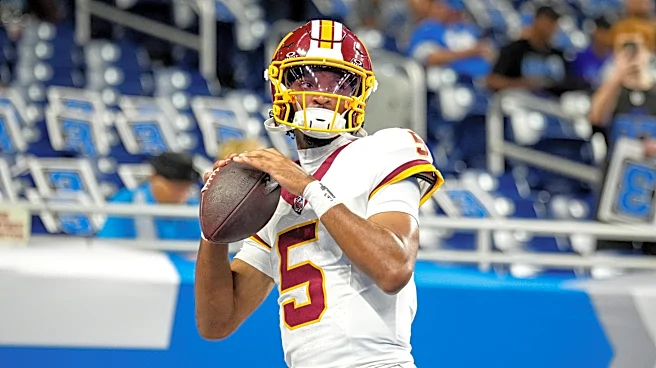
Washington Commanders quarterback Jayden Daniels is drawing attention for his cautious approach to the game, despite a strong statistical start to the season. Through four games, Daniels has completed 75 of 116 passes for 759 yards, with five touchdown
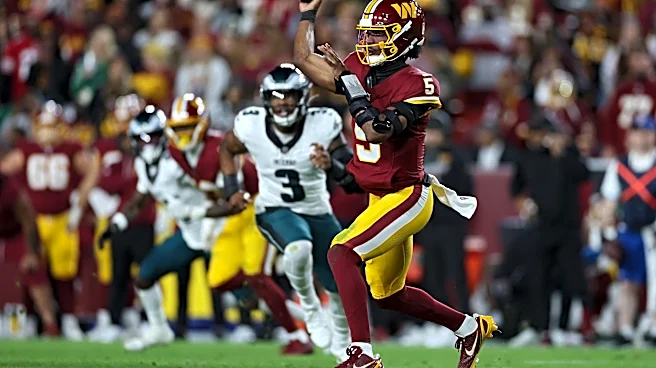
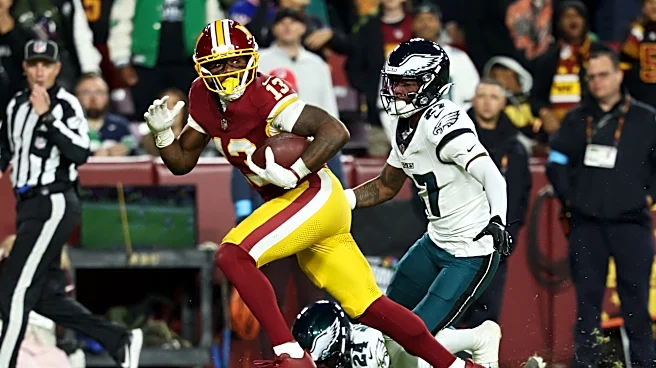
passes and no interceptions, resulting in a 97.6 passer rating, according to StatMuse. This clean, efficient play has led to a modest total for a quarterback with his arm talent. Prominent former quarterbacks, including ESPN analyst Dan Orlovsky, have voiced opinions that Daniels needs to take more risks to elevate his game to an elite level. This critique suggests that while protecting the football is valuable, a lack of aggressive downfield throws might be limiting the offense's potential, especially with a thin receiving group due to Terry McLaurin's injury. The Commanders recently secured a 27-10 victory over the Philadelphia Eagles, but the offense settled for four field goals, highlighting the perceived caution. Daniels posted a 57.1 passing grade in that game, with his 76.0 rushing grade being the strongest aspect of his performance.
Why It's Important?
The debate surrounding Jayden Daniels' playstyle is significant for the Washington Commanders' season trajectory and his development as a franchise quarterback. His current cautious approach, while minimizing turnovers, may hinder the team's ability to consistently score touchdowns rather than field goals, which is crucial for competing in the NFC East. With the team sitting two games behind the Giants, maximizing offensive output is paramount. The critique from former NFL quarterbacks underscores a common challenge for young signal-callers: balancing risk-ataking with ball security. If Daniels continues to prioritize caution, it could limit the offense's explosiveness and make it harder to overcome deficits or keep pace with high-scoring opponents. Conversely, forcing throws could lead to turnovers, which are equally detrimental. The team's receiving corps, weakened by injuries, further complicates this balance, as Daniels may feel less inclined to attempt riskier passes without his top target. His performance against upcoming defenses, like the Rams, will be a key indicator of whether his patience is a strength or a limiting factor.
What's Next?
Jayden Daniels and the Washington Commanders are set to face the Los Angeles Rams next, a matchup that will further test Daniels' playstyle. The Rams' defense, with Myles Garrett returning to practice, presents a significant challenge that will scrutinize whether Daniels' cautious approach is a sustainable strength or a ceiling for his performance. The Commanders' coaching staff and Daniels himself will need to evaluate the balance between protecting the football and taking calculated risks to generate more explosive plays. With Terry McLaurin on injured reserve, the onus is on Daniels to elevate the play of other receivers, such as rookie Antonio Williams, who played 83% of snaps against Philadelphia. An increase in downfield attempts to these players could address the critiques from analysts. The team's ability to convert drives into touchdowns rather than field goals will be critical for their standing in the NFC East, where they are currently two games behind the Giants. Future games will reveal if Daniels adjusts his approach or maintains his current style.
Beyond the Headlines
The ongoing discussion about Jayden Daniels' cautious play extends beyond immediate game results, touching upon the philosophical debate within quarterback development in the NFL. Modern quarterback play often emphasizes efficiency and minimizing turnovers, yet the ability to make high-leverage, aggressive throws is also a hallmark of elite passers. Daniels' situation highlights the tension between these two ideals. His current approach, while statistically clean, raises questions about his ceiling and whether he can evolve into a quarterback who can consistently make game-changing plays under pressure. This also reflects on the coaching philosophy of the Commanders, and how they intend to mold their young quarterback. The long-term implications involve Daniels' growth as a leader and decision-maker; if he can integrate more calculated risks into his game without sacrificing ball security, he could unlock a new level of performance. Conversely, if he remains overly cautious, it might limit the team's offensive potential and his own development into a top-tier NFL quarterback, impacting future roster decisions and team strategy.