






What's Happening?
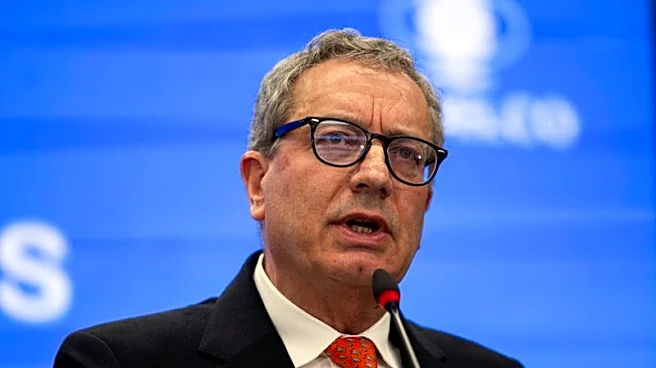
Bernardo Fontaine, board chairman of Chile's state-owned miner Codelco, has stated that the company's copper production will continue to fall unless it forms partnerships with private firms to develop new projects. Codelco has faced challenges in recovering
its output, experiencing record lows between 2022 and 2023 due to project delays, accidents, low ore grades, and a scandal involving inflated production figures. Fontaine highlighted that Codelco possesses a million hectares of unexploited mining concessions but lacks the management capacity and capital to develop them independently. He noted that existing legislation complicates the formation of such partnerships, deterring potential collaborators, despite Codelco's previous collaborations with global mining giants like Rio Tinto and BHP. The new management aims to achieve an average annual production of around 1.3 million tonnes.
Why It's Important?
Codelco's need for private partnerships to halt its copper output decline has significant implications for the global copper market and, by extension, for U.S. industries reliant on copper. As the world's largest copper producer, Codelco's production levels directly influence global supply and pricing. A continued decline could lead to higher copper prices, impacting U.S. sectors such as electronics, construction, and renewable energy, which depend heavily on this critical metal. The call for private investment also highlights the challenges faced by state-owned enterprises in managing vast natural resources efficiently and sustainably. For U.S. mining companies and investors, this situation could present opportunities for strategic partnerships in Chile, potentially diversifying their portfolios and securing access to vital resources, while also navigating the complexities of foreign investment regulations.
What's Next?
Codelco's next steps will likely involve actively seeking and negotiating with private mining firms for joint ventures to develop its unexploited concessions. This process will require navigating and potentially advocating for changes in Chilean legislation that currently hinder such partnerships. The company's new management team will need to demonstrate a clear strategy for project development and operational efficiency to attract credible private investors. Success in forming these partnerships will be crucial for Codelco to achieve its target of 1.3 million tonnes in annual production and stabilize its role in the global copper market. The outcomes of these efforts will be closely watched by international commodity markets and industries dependent on copper supply.
Beyond the Headlines
Codelco's struggle to maintain copper output and its reliance on private partnerships underscore a broader global trend where resource-rich nations grapple with the balance between national control and the need for foreign investment and expertise. This situation highlights the complex interplay of economic policy, environmental concerns, and geopolitical interests in the mining sector. The 'excessive optimism' that led to inflated production figures also points to governance challenges within state-owned enterprises, emphasizing the importance of transparency and realistic forecasting. The long-term implications could include a re-evaluation of state-owned mining models, potentially leading to more hybrid ownership structures globally. For the U.S., ensuring a stable and affordable supply of critical minerals like copper is a matter of national economic security and industrial competitiveness, making Codelco's strategic decisions of significant interest.