



What's Happening?
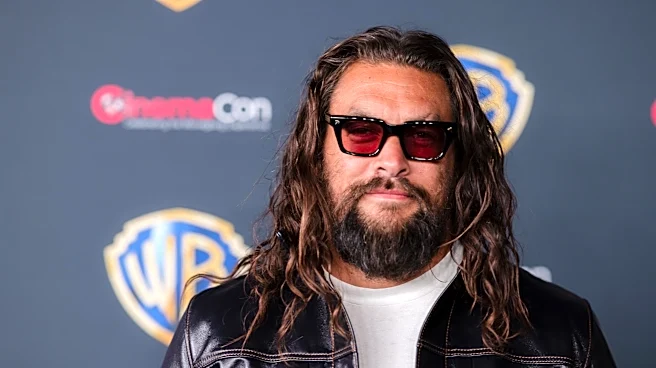
Actor Jason Momoa has revealed that his role as Hayt in the upcoming 'Dune: Part Three' is the most challenging character he has ever portrayed. In an interview with The New York Times, Momoa described the complexity of playing a character who is a genetically
engineered clone-like being, created from the genetic material of Duncan Idaho, a character he previously played in the first 'Dune' film. Hayt retains muscle memory and some genetic traits but lacks Duncan Idaho's full memories or personality. Momoa noted the difficulty in navigating a character who doesn't know his own identity, especially as he joined the production while filming was already underway and without the direct guidance of director Denis Villeneuve, as he had in the first movie. He characterized this performance as his most subtle to date, a departure from his usual acting style. 'Dune: Part Three' is scheduled for release on December 18, 2026.
Why It's Important?
This development is significant for fans of the 'Dune' franchise and for those interested in Momoa's acting career. His portrayal of Hayt presents a unique artistic challenge, requiring a nuanced performance that deviates from his more action-oriented roles. The character of Hayt is intended to be a gift to Paul Atreides but also a means to weaken him, adding a complex layer to the narrative. Momoa's ability to embody a character with a fragmented identity and no prior memories will be a critical element in the film's emotional and thematic depth. This role could showcase a different facet of Momoa's acting range, potentially broadening perceptions of his capabilities beyond his established persona in roles like Aquaman. The success of his performance will be crucial for the continued critical reception of the 'Dune' saga.
What's Next?
As 'Dune: Part Three' progresses towards its December 18, 2026 release, audiences can anticipate more details about Momoa's portrayal of Hayt. Future promotional materials, such as trailers and additional interviews, are likely to offer further insights into the character's development and his interactions within the film's narrative. The film's release will be a key moment for critics and audiences to evaluate Momoa's performance in this challenging role. His interpretation of Hayt, a character with a complex origin and purpose, will be a focal point of discussion. The success of this performance could influence future casting decisions for Momoa, potentially leading to more roles that demand subtle and intricate character work.
Beyond the Headlines
Momoa's experience with the Hayt character touches upon deeper themes of identity, memory, and the nature of self, which are central to Frank Herbert's 'Dune' universe. The concept of a 'ghola'—a clone-like being without the original's full memories—raises philosophical questions about what constitutes an individual's essence. For Momoa, stepping into such a role requires not just acting skill but also an understanding of these complex existential ideas. This role could be a turning point in his career, allowing him to explore more profound and introspective characters. It also highlights the evolving nature of blockbuster cinema, where actors are increasingly challenged to deliver performances that are both entertaining and intellectually stimulating, pushing the boundaries of character development in large-scale productions.