






What's Happening?
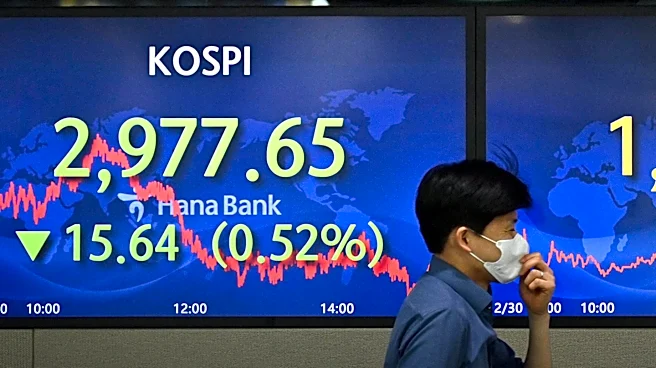
The KOSPI, Korea's stock market index, experienced a significant plunge, falling nearly 50% from its peak, driven by fears surrounding the U.S. artificial intelligence (AI) and semiconductor value chain. This sharp decline occurred despite broader Korean
financial markets, such as credit default swap (CDS) premiums and government bond yields, remaining relatively stable. The shock originated in the United States, with Nvidia's stock plummeting 14.01% after reports emerged on November 20th (local time) that the U.S. Securities and Exchange Commission (SEC) was examining the company's accounting practices. Analysts suggest that the perception that positive AI news no longer boosts investor sentiment contributed to the downturn. The Korean stock market's heavy concentration in semiconductor stocks, with Samsung Electronics and SK hynix accounting for over 50% of the main market's capitalization, amplified the impact of the AI sector's struggles on the KOSPI.
Why It's Important?
The KOSPI's dramatic fall, while broader financial indicators remain calm, highlights the disproportionate influence of the AI and semiconductor sectors on certain national economies, particularly those with concentrated market structures like Korea's. The U.S. SEC's examination into Nvidia's accounting practices underscores the regulatory scrutiny faced by major tech companies, which can trigger significant market reactions globally. This event suggests that investor confidence in the AI sector, previously a strong driver of growth, is becoming more sensitive to external factors and regulatory oversight. For U.S. investors and companies, the ripple effect on international markets demonstrates the interconnectedness of the global financial system and how developments in one major tech company can have far-reaching consequences.
What's Next?
The immediate focus for investors will be on the outcome of the SEC's examination into Nvidia's accounting practices, as this could set a precedent for regulatory oversight in the AI sector. Analysts are advising investors to look for confirmation of interest rate outlooks and sustained corporate earnings growth rather than expecting a rebound solely based on current stock valuations. There is also an expectation that a shift in the U.S. Federal Reserve's interest rate outlook could help restore liquidity to markets. The high concentration of semiconductor stocks in the KOSPI means that any further developments in the global AI and chip industries, including regulatory actions or shifts in investor sentiment, will continue to have a significant impact on the Korean market.
Beyond the Headlines
This market event reveals a potential vulnerability in economies heavily reliant on a few dominant sectors or companies, particularly in rapidly evolving fields like AI. The disconnect between the stock market's performance and broader financial stability indicators suggests that the current downturn might be more of a sector-specific correction rather than a systemic crisis. However, it also raises questions about the sustainability of growth driven by speculative enthusiasm in emerging technologies. The incident could prompt a re-evaluation of investment strategies, encouraging greater diversification and a more cautious approach to high-growth, high-valuation sectors. It also highlights the increasing role of regulatory bodies in shaping market dynamics and investor confidence in the technology industry.