



What's Happening?
Adam Prestidge, president of Glenfarne Alaska LNG, has stated that the Alaska liquified natural gas (LNG) pipeline project is gaining significant momentum. Speaking at the Resource Development Council for Alaska (RDC) annual convention in Anchorage, Prestidge outlined
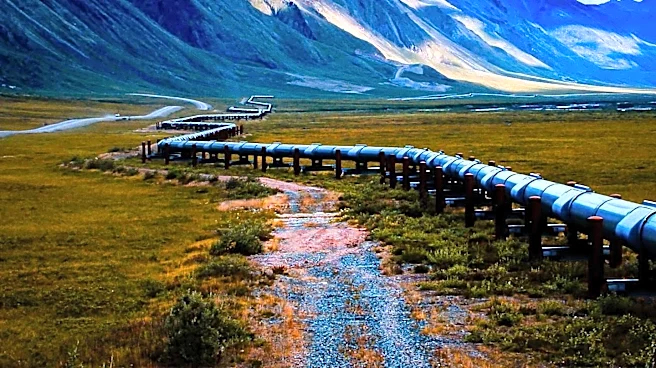
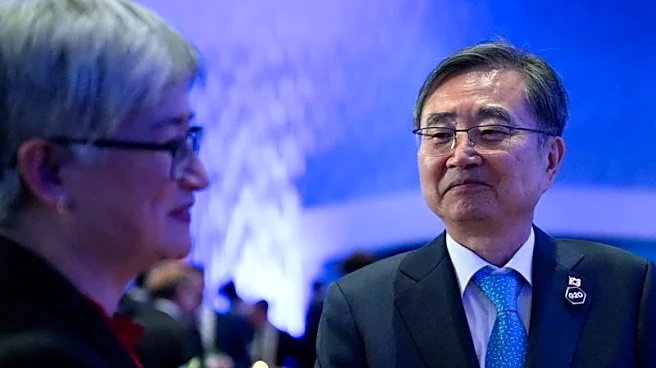
two potential paths for the project: a Korean financing route and a private financing route. Both options share the common goal of constructing an 800-mile gasline from the North Slope to Southcentral Alaska. The Korean financing framework, announced at the White House in September, involves the South Korean government studying the commercial viability of investing in the project through the U.S. Department of Commerce. This framework offers an alternative to Glenfarne's previous approach, which faced challenges when the Alaska Legislature did not reform property taxes for the pipeline's route after three special sessions. Under the Korean scenario, property taxes would not be an issue.
Why It's Important?
The affirmation of 'real momentum' for the Alaska LNG pipeline project carries significant economic and strategic implications for the U.S. and Alaska. The project, if realized, would unlock vast natural gas reserves, potentially creating numerous jobs, stimulating local economies, and establishing Alaska as a major energy exporter. The involvement of the South Korean government and the U.S. Department of Commerce through a bilateral investment framework highlights a strategic partnership aimed at bolstering U.S. infrastructure and energy projects, with a $200 billion portfolio. This could provide a faster and more secure path to a final investment decision (FID) compared to purely private financing, which Prestidge indicated would have a longer timeline. The exemption from property taxes under the Korean scenario also addresses a key hurdle that previously stalled the project, making it more financially viable and attractive to investors.
What's Next?
Glenfarne is currently engaged in detailed discussions with the U.S. Department of Commerce to structure the project for Korean investment. Prestidge expressed enthusiasm for this option, viewing it as the fastest route to an immediate final investment decision (FID) and the commencement of work. Under this framework, a subsidiary called Project North would be established as a special purpose vehicle for the Alaska LNG pipeline, acquiring Glenfarne's 75 percent stake and converting Glenfarne into the project manager. The remaining 25 percent would be held by the state-owned Alaska Gasline Development Corporation. If this path is successful, the project could move forward rapidly, potentially bypassing the legislative hurdles related to property taxes that previously complicated its progress. The alternative private financing route remains an option, though it is expected to have a longer timeline.
Beyond the Headlines
The Alaska LNG pipeline project, with its potential Korean investment, represents a significant shift in how large-scale infrastructure projects in the U.S. might be financed and executed. The bilateral investment framework involving the U.S. Department of Commerce and a foreign government could set a precedent for future collaborations on critical infrastructure and energy initiatives. This approach not only addresses financial and logistical challenges but also strengthens international economic ties and energy security. The project's ability to circumvent previous legislative obstacles through this new framework highlights the adaptability and strategic thinking required for such complex undertakings. Furthermore, the long-term implications for Alaska's energy landscape and its role in global energy markets could be transformative, potentially leading to increased economic diversification and geopolitical influence for the state.