







What's Happening?
Wing, Alphabet's drone delivery subsidiary, announced a significant investment of up to $125 million over the next two years to construct a manufacturing facility in Fort Worth, Texas. This factory is designed to produce tens of thousands of delivery aircraft
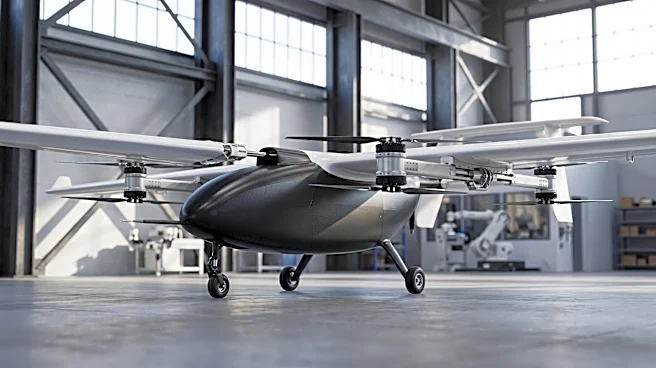
annually and is expected to create up to 100 jobs. This marks Wing's first dedicated U.S. manufacturing facility, signaling a strategic shift towards competing on production volume to achieve economic viability in drone delivery. The drone delivery industry currently faces a cost problem, with per-delivery costs ranging from $15 to $25, needing to drop to $8 to $12 for profitability. Wing's approach involves an 'Aircraft Library' of validated hardware and software components shared across various airframe configurations, reducing engineering costs and simplifying the supply chain. The company's current hybrid aircraft design, utilizing both vertical lift rotors and fixed wings, offers energy efficiency and a tether delivery system that allows packages to be lowered from a hover, enhancing speed and reducing infrastructure needs.
Why It's Important?
This investment by Wing is a critical move for the U.S. drone delivery industry, addressing the long-standing challenge of scaling production to achieve profitability. By focusing on domestic manufacturing, Wing aligns with federal policies supporting U.S. drone production and supply chain resilience, especially in light of import tariffs and bans on foreign-made drones. The Fort Worth factory aims to reach the production threshold of approximately 10,000 units per year, which industry analysis suggests is necessary for significant unit cost reduction through the aerospace learning curve. This could dramatically lower the depreciation component of each delivery, making drone services more economically competitive. The expansion of Wing's manufacturing capacity is essential to meet the growing demand, particularly from partners like Walmart, which plans to expand its drone delivery program to over 270 store locations by 2027, reaching an estimated 40 million Americans. This development could accelerate the widespread adoption of drone delivery services across the U.S., impacting logistics, retail, and consumer expectations.
What's Next?
The Fort Worth facility is expected to ramp up production over the next two years, with the goal of producing tens of thousands of aircraft annually. This increased capacity will enable Wing to expand its operations beyond its current 70 sites and into nearly 20 U.S. markets by 2027. A key factor for Wing's ability to scale will be the finalization of the FAA's proposed Part 108 rule, which aims to replace market-by-market Beyond Visual Line of Sight (BVLOS) waivers with a standardized compliance framework. This rule, currently under review by the Office of Information and Regulatory Affairs (OIRA), is crucial for allowing Wing to expand from 20 to 200 markets efficiently. However, a recent petition by a 15-state coalition and Harris County, Texas, challenging the FAA's environmental assessment for drone package delivery, could introduce regulatory friction, potentially impacting the pace of expansion. Wing will also need to continue its focus on community engagement to address concerns about noise, privacy, and airspace congestion.
Beyond the Headlines
Wing's substantial investment in a U.S. manufacturing facility signifies a pivotal moment for the drone delivery sector, moving it from experimental phases to industrial-scale production. This shift has profound implications for the future of last-mile logistics, potentially transforming how goods are delivered in suburban and urban areas. The success of this venture could set a precedent for other companies in the advanced air mobility space, emphasizing the importance of domestic manufacturing capabilities and robust supply chains. However, the economic viability of drone delivery at scale still hinges on several factors beyond production, including regulatory clarity, public acceptance, and the ability to maintain competitive pricing. The environmental and social impacts, such as noise pollution and privacy concerns, will also need continuous management and innovation. If successful, Wing's model could lead to a more efficient, faster, and potentially more sustainable delivery ecosystem, but it also raises questions about job displacement in traditional delivery sectors and the equitable distribution of these new services.