




What's Happening?
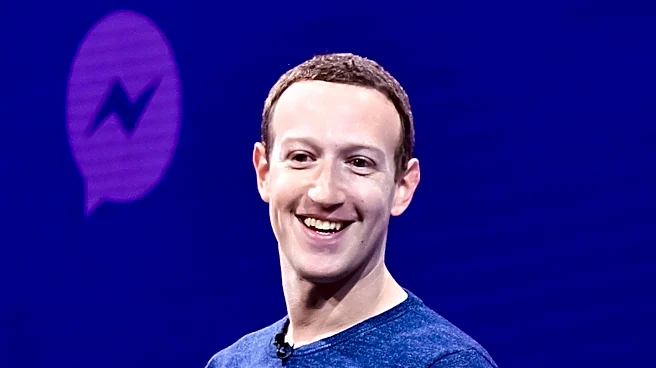
Mark Zuckerberg, the founder of Facebook, currently holds a net worth of $227 billion, positioning him as the fifth wealthiest individual globally, according to Bloomberg data. His wealth has seen fluctuations throughout 2026, aligning with the performance
of Meta stock, and peaked at $274 billion in September. Zuckerberg maintains significant control over Meta Platforms, owning approximately 13% of its shares and controlling the voting shares. On a recent Monday, his net worth increased by $10.7 billion, marking a 5% gain. Year-to-date, Zuckerberg's wealth has grown by $7.72 billion, which is among the lower gains for the top ten billionaires, surpassing only Sergey Brin and Larry Ellison. He began the year ranked sixth among billionaires, moving up one position.
Why It's Important?
The substantial net worth of Mark Zuckerberg and his control over Meta Platforms have significant implications for the technology sector and philanthropic initiatives. His considerable stake in Meta grants him immense influence over the company's strategic direction, product development, and market position, directly impacting the social media landscape and digital advertising industry. The fluctuations in his net worth, tied to Meta's stock performance, reflect broader trends and investor confidence in the tech giant. Furthermore, Zuckerberg and his wife, Priscilla Chan, have publicly committed to donating 99% of their Meta shares during their lifetimes, building on a 2010 pledge to give away at least half of their net worth. This philanthropic commitment, which has seen his fortune surge by $182 billion since 2015 to fund these efforts, highlights a growing trend among ultra-wealthy individuals to address societal challenges through large-scale donations, potentially redirecting vast sums of capital towards various causes rather than intergenerational wealth transfer.
What's Next?
The trajectory of Mark Zuckerberg's net worth will continue to be closely tied to the performance of Meta Platforms stock, influenced by market trends, technological advancements, and regulatory developments in the social media and AI sectors. His ongoing control over Meta's voting shares suggests a continued hands-on approach to the company's future, which could involve further investments in areas like artificial intelligence and the metaverse. Concurrently, the execution of his and Priscilla Chan's philanthropic pledges will likely see substantial transfers of wealth to charitable causes over their lifetimes. This commitment could lead to the establishment of new philanthropic initiatives or significant funding for existing organizations, potentially impacting various sectors such as education, health, and scientific research. The specific allocation and impact of these funds will be a key area to watch as their philanthropic efforts mature.
Beyond the Headlines
Mark Zuckerberg's immense wealth and his decision to pledge the majority of it to philanthropy raise broader questions about wealth distribution, corporate power, and the role of billionaires in shaping society. His control over Meta, a company with billions of users, gives him unparalleled influence over global communication and information flow, prompting ongoing debates about censorship, data privacy, and algorithmic bias. The philanthropic pledge, while significant, also highlights the concentration of wealth in the hands of a few individuals and the potential for private foundations to exert considerable influence over public policy and social agendas. This model of philanthropy, where vast sums are directed by a select few, contrasts with traditional democratic processes and can spark discussions about accountability and transparency in charitable giving. The long-term impact of such concentrated power, both corporate and philanthropic, on democratic institutions and societal equity remains a complex and evolving issue.