
What's Happening?
Tesla has initiated the rollout of its Full Self-Driving (FSD) v15 software, which includes a new feature called Reality View. This update, announced on November 21, 2026, by Tesla's VP of AI Software Ashok Elluswamy and Elon Musk, introduces a photorealistic
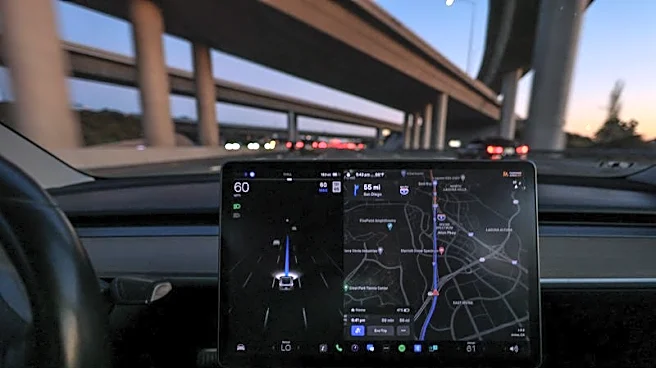
live visualization of the road and the vehicle's intended actions. Elluswamy highlighted that this new display is more computationally efficient than previous visualizations, despite offering enhanced graphics. The FSD v15 release notes indicate that the software claims a '25x better handling of safety critical cases.' The update is being released to an initial wave of customers, with a broader rollout anticipated in December. The Reality View aims to provide drivers with a clearer understanding of the FSD system's intentions, displaying planned routes and upcoming turns with new arrows directly on the driving scene.
Why It's Important?
The introduction of FSD v15 with Reality View marks a significant advancement in Tesla's autonomous driving technology, potentially impacting the automotive industry and the future of transportation. The claim of '25x better handling of safety critical cases' suggests a substantial improvement in the system's ability to navigate complex driving scenarios, which could enhance public trust and accelerate the adoption of self-driving vehicles. The increased computational efficiency of Reality View is also crucial, as it allows for more sophisticated visualizations without overburdening the vehicle's processing power, potentially leading to more reliable and responsive autonomous systems. This development could influence regulatory discussions around autonomous vehicle safety and functionality, setting new benchmarks for what consumers expect from advanced driver-assistance systems. The broader rollout in December indicates Tesla's commitment to scaling this technology, which could further solidify its position in the competitive autonomous vehicle market.
What's Next?
Following the initial rollout to a select group of customers, Tesla plans a wider release of FSD v15 in December. This broader deployment will allow more users to experience the new Reality View and the claimed safety improvements. The performance and user feedback from this expanded release will be critical in evaluating the real-world effectiveness and reliability of FSD v15. Regulatory bodies and safety organizations will likely monitor the performance of this new version closely, especially given the claims of enhanced safety. Future updates may focus on further refining the Reality View, integrating additional features, and expanding the operational design domain of FSD. The ongoing development and deployment of such advanced autonomous driving features will continue to shape the regulatory landscape and public perception of self-driving technology.
Beyond the Headlines
The shift to a photorealistic Reality View in FSD v15 goes beyond a mere visual upgrade; it represents a deeper integration of the vehicle's AI with human understanding. By providing a clearer, more intuitive representation of the car's intentions, Tesla aims to build greater trust and transparency between the driver and the autonomous system. This could have profound implications for the psychological acceptance of self-driving cars, as drivers may feel more comfortable relinquishing control when they can clearly see and understand the vehicle's decision-making process. The emphasis on computational efficiency also highlights a critical challenge in AI development: achieving advanced capabilities while optimizing resource usage. This efficiency could enable more complex AI models to run on embedded systems, pushing the boundaries of what's possible in edge computing for autonomous applications. The evolution of FSD visualizations from wireframe to photorealistic also reflects a broader trend in human-computer interaction, where interfaces are becoming increasingly immersive and intuitive to bridge the gap between artificial intelligence and human cognition.