






What's Happening?
Writer, teacher, and mother Jennifer Case is advocating for an approach to parenting that encourages children to care deeply about the living world and other people, without burdening them with the full weight of global problems like climate change. Drawing
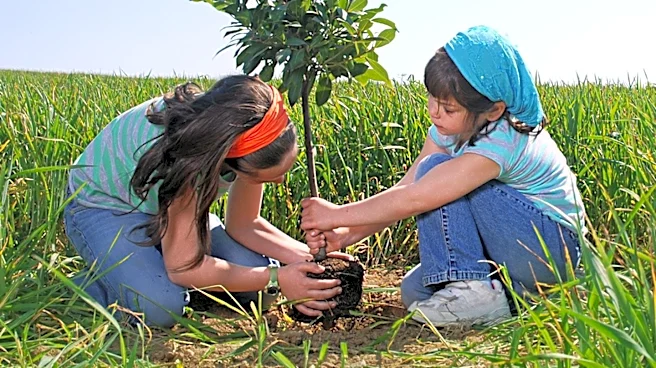
from her own experiences backpacking Minnesota’s Superior Hiking Trail, where she found a sense of safety and connection to nature, Case emphasizes the importance of fostering wonder in children. She observed her daughter having a similar experience at ecology camp, journaling on a rocky overlook. Case's perspective, discussed in the 'Raising Wild' podcast, suggests that caregiving can be viewed as climate work, and that families should not be isolated in raising children. She also highlights the importance of engaging in joyful, caring communities, such as volunteering with local food networks or caring for backyard chickens, as ways to participate in environmental stewardship.
Why It's Important?
Jennifer Case's approach is significant for addressing the growing concern of climate anxiety among younger generations. By advocating for a balance between awareness and wonder, she offers a framework for parents and educators to discuss environmental issues constructively, preventing overwhelming fear while still promoting responsibility. This perspective can empower children to become active participants in environmental solutions rather than feeling helpless. Furthermore, her emphasis on community engagement and practical actions, like volunteering or backyard farming, provides tangible ways for families to contribute to a sustainable future. This fosters a sense of agency and connection, which is crucial for developing resilient and compassionate individuals who are motivated by love rather than fear in their environmental efforts. This approach can shape future generations' engagement with environmental challenges.
What's Next?
Jennifer Case's ideas are likely to influence discussions among parents, educators, and environmental advocates on how to best engage children with climate change and environmental stewardship. Her book, 'The Carework Project: Reckoning with Love, Labor, and the Living World,' will further disseminate her philosophy, potentially leading to workshops, educational programs, and community initiatives centered on her principles. There may be a growing emphasis on integrating nature-based learning and community service into educational curricula, focusing on hands-on experiences that build connection and care. Parents might increasingly seek out resources and communities that support this balanced approach, fostering a generation that is both informed and hopeful about the future of the planet. The conversation around climate education could shift towards more empowering and less fear-driven narratives.
Beyond the Headlines
The core of Jennifer Case's message delves into the ethical and psychological dimensions of raising children in an era of environmental uncertainty. It challenges the conventional wisdom that direct, unmitigated exposure to environmental crises is the most effective way to foster action. Instead, she proposes that nurturing a deep, loving connection to the natural world and fostering a sense of community can be more powerful motivators for long-term engagement and resilience. This approach has profound implications for mental health, suggesting that a focus on joy, wonder, and collective action can counteract feelings of helplessness and despair. It also highlights the interconnectedness of personal well-being, community health, and environmental sustainability, positioning caregiving as a fundamental act of ecological responsibility. This perspective could lead to a re-evaluation of how society prepares its youngest members to inherit and protect the planet.