






What's Happening?
SEA-LNG has announced that Amazónica LNG, a Colombian LNG import, storage, and regasification company, has joined its coalition. This membership marks SEA-LNG's first expansion into South America, with Amazónica LNG developing bunkering infrastructure
on Colombia's Caribbean coast. Amazónica LNG, a joint venture between Retramar and Affinity Energy, operates the Palermo LNG terminal near Barranquilla, which combines a floating storage unit with regasification and small-scale LNG distribution capabilities. The company's CEO, Alberto Consuegra, stated that this move aims to unlock LNG as a practical transition fuel for the region and advance shipping decarbonization, positioning Cartagena and the Colombian Caribbean as a future-ready bunkering hub for Latin America and the wider Caribbean.
Why It's Important?
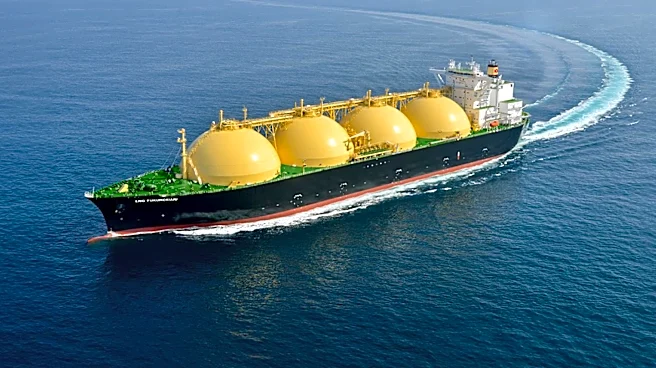
The inclusion of Amazónica LNG in SEA-LNG is significant for the global maritime industry's decarbonization efforts and the expansion of LNG as a marine fuel. With regulatory requirements tightening across international shipping, LNG and its bio- and synthetic derivatives (liquefied biomethane and e-methane) are being promoted as a viable decarbonization pathway. The establishment of LNG bunkering infrastructure in strategic locations like Colombia's Caribbean coast, which handles a substantial volume of maritime traffic, is crucial for the global adoption of methane as a marine fuel. This development provides a critical hub for vessels operating in Latin America, offering a cleaner alternative to traditional fossil fuels and supporting the industry's transition towards lower-emission operations. The growth of such infrastructure is essential for increasing the number of LNG-fueled vessels, which currently account for almost 90% of all alternative-fuel ships on order.
What's Next?
Amazónica LNG's membership is expected to expand SEA-LNG's network and foster collaboration among various stakeholders, including vessel owners, ports, fuel producers, and equipment manufacturers, all focused on growing the global methane marine fuel value chain. The company's infrastructure on Colombia's Caribbean coast is poised to accelerate the adoption of the methane pathway in Latin America. As LNG bunkering infrastructure continues to expand globally, with over 220 ports already offering such services, the focus will be on further developing the supply chain and ensuring the availability of LNG and its derivatives. This will involve continued investment in port facilities, storage, and distribution networks, as well as ongoing research and development into methane slip technology to enhance the environmental performance of LNG as a marine fuel. The industry will also monitor evolving regulatory frameworks to ensure compliance and drive further decarbonization efforts.
Beyond the Headlines
The integration of Amazónica LNG into SEA-LNG underscores a broader trend in the maritime sector: the strategic pivot towards alternative fuels to meet increasingly stringent environmental regulations. While LNG is presented as a 'transition fuel,' its long-term role in a fully decarbonized shipping industry is a subject of ongoing debate, particularly concerning methane slip – the release of uncombusted methane, a potent greenhouse gas. This development highlights the complex interplay between economic development, energy security, and environmental sustainability. For Latin America, the establishment of LNG bunkering hubs could stimulate regional economic activity and create new opportunities in the energy sector. However, it also raises questions about the region's long-term energy strategy and its commitment to truly zero-emission fuels. The success of such initiatives will depend on continuous technological advancements, robust regulatory frameworks, and a clear pathway towards more sustainable marine fuels beyond LNG.