
What's Happening?
Hyundai Motor Group is intensifying its efforts in self-driving technology by implementing a 'data flywheel' strategy, aiming to surpass rivals like Tesla in accumulated data volume by 2033. This approach
involves a self-reinforcing cycle where data collected from vehicles is used to train and validate artificial intelligence models, which are then deployed back into vehicles to gather new data. The group, which sells over 7 million vehicles annually across approximately 190 countries, believes its extensive sales network will enable rapid accumulation of real-world driving data once self-driving systems are mass-produced. Hyundai plans to introduce Level 2+ autonomous driving functions using Nvidia solutions in mass-produced vehicles by the first half of 2028, followed by Level 2++ features in the second half of the same year. By the second half of 2029, the group intends to mass-produce Level 2++ vehicles based on its proprietary Atria AI platform.
Why It's Important?
This strategic shift by Hyundai Motor Group has significant implications for the U.S. automotive market and the broader technology landscape. As a major player in the U.S. auto industry, Hyundai's accelerated self-driving development could intensify competition with domestic manufacturers and other international brands. The focus on a 'data flywheel' underscores the critical role of data in advancing autonomous driving, potentially leading to a race among automakers to collect and process vast amounts of real-world driving information. This could influence consumer adoption of self-driving features, regulatory frameworks for autonomous vehicles, and the development of related infrastructure in the U.S. Furthermore, the integration of advanced AI models like Vision-Language-Action (VLA) could set new benchmarks for vehicle intelligence and safety, impacting U.S. road safety standards and insurance models. The move also highlights the growing convergence of the automotive and technology sectors, with implications for talent acquisition and investment in AI and software development within the U.S.
What's Next?
Hyundai Motor Group plans to expand its self-driving technology in stages, with Level 2+ functions based on Nvidia solutions in mass-produced vehicles by early 2028, and Level 2++ features later that year. By 2029, the group aims for mass production of Level 2++ systems using its in-house Atria AI platform. The company is also preparing for safety certification in North America and Europe by 2029. To support these goals, Hyundai is currently operating about 40 dedicated data collection vehicles and employing advanced AI training techniques such as hard example mining, continuous training, and a special event recorder. The group is also establishing a 'data union' to integrate sensor data across its various entities, including its U.S. robotaxi joint venture, Motional. The introduction of VLA models is expected to further enhance the reasoning capabilities of its autonomous driving systems, with potential applications extending into robotics.
Beyond the Headlines
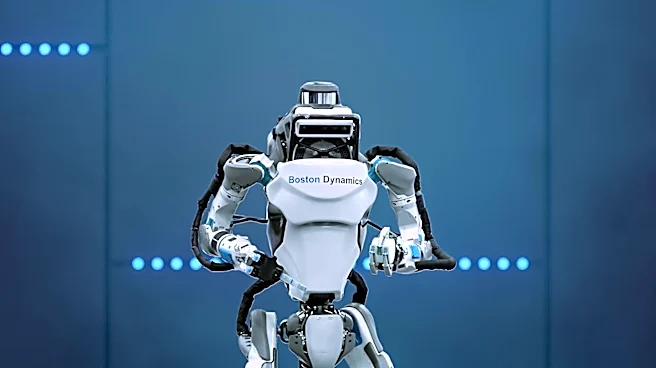
The emphasis on a 'data flywheel' and proprietary AI platforms by Hyundai Motor Group points to a deeper trend in the automotive industry: the transformation of car manufacturers into software and AI companies. This shift has profound implications for the future of mobility, potentially leading to vehicles that continuously learn and improve over their lifespan. The ethical considerations surrounding data privacy, algorithmic bias, and the accountability of AI in autonomous decision-making will become increasingly prominent. Furthermore, the development of VLA models, which combine visual recognition, language-based reasoning, and action generation, could pave the way for 'physical AI' that can understand, reason, and act in complex real-world environments, extending beyond vehicles into robotics and other domains. This could trigger a new wave of innovation and disruption across various industries, impacting employment, infrastructure, and societal norms.