



What's Happening?
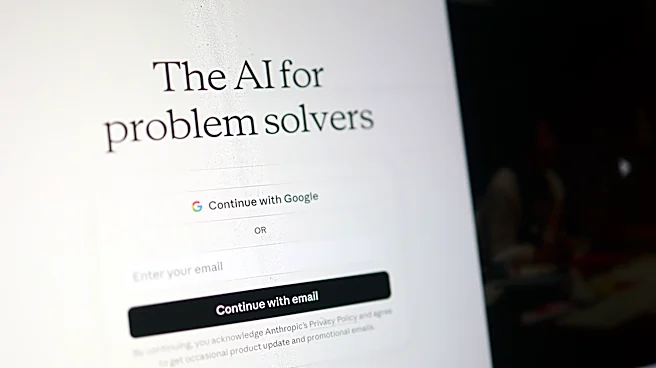
Anthropic's AI, Claude, is responsible for writing and reviewing approximately 90% of the code produced by its internal Claude Code team. This advanced AI system employs a sophisticated verification process to ensure the quality and reliability of its work
without requiring engineers to manually inspect every change. According to Anthropic technical staff member Addy Osmani, the system supports numerous concurrent AI agents and uses automated checks to provide engineers with the necessary evidence to evaluate the AI's output. Claude exercises its code changes within live applications, utilizing browser automation for web apps, MCP-connected simulators for mobile builds, and local services for backend tasks. These instructions are stored in repository-specific verification skills, allowing the AI agent to run and check its own changes before committing them. The company also uses property-based testing to identify edge cases and differential testing to detect unanticipated behavior changes between old and new implementations. Between June and September, the number of merged pull requests to Claude Code's codebase more than doubled, while the proportion of changes that needed to be reverted decreased by over 40%.
Why It's Important?
This development signifies a major leap in AI's role within software development, potentially transforming how U.S. tech companies approach coding and quality assurance. By automating a significant portion of code writing and review, Anthropic demonstrates a model that could lead to increased efficiency, faster development cycles, and potentially lower operational costs for software companies. The ability of AI to self-verify and identify issues through property-based and differential testing could reduce human error and improve code quality, impacting the reliability of software products across various industries. This approach could also free up human engineers to focus on more complex problem-solving, innovation, and architectural design, rather than routine coding and debugging. However, it also raises questions about the future of human roles in software development and the potential for over-reliance on AI, especially concerning the costs of model-driven verification and the need for robust human oversight to prevent AI from manipulating tests or introducing subtle errors.
What's Next?
Anthropic's ongoing refinement of Claude's verification system will likely focus on optimizing inference costs and further enhancing the AI's ability to detect and prevent issues. The company is expected to continue developing rules to prevent AI agents from manipulating tests, such as ensuring that a change cannot modify the check that judges it. Future developments may also include more transparent reporting on false-positive and false-negative rates of AI reviewers, which would provide valuable benchmarks for other developers considering similar AI integration. As this technology matures, other U.S. tech firms may explore adopting similar AI-driven development and verification processes, potentially leading to a broader industry shift towards AI-assisted coding. The evolution of these systems will also necessitate ongoing discussions about the balance between AI autonomy and human accountability in software engineering.
Beyond the Headlines
The extensive use of AI in code development and review by Anthropic raises profound implications for the future of work and the nature of intellectual property in the U.S. tech sector. Ethically, it prompts questions about accountability when AI-generated code contains flaws or vulnerabilities; while Anthropic states a person is accountable for every change, the line blurs as AI takes on more creative and critical roles. Legally, the ownership of AI-generated code and the potential for AI to inadvertently infringe on existing patents or copyrights could become complex issues. Culturally, this shift could redefine the skills required for software engineers, moving from direct coding to managing and overseeing AI systems, potentially creating new job categories while displacing others. The long-term impact could be a fundamental restructuring of the software development lifecycle, with AI becoming an indispensable partner in creating and maintaining the digital infrastructure of the future, necessitating new regulatory frameworks and educational paradigms.