






What's Happening?
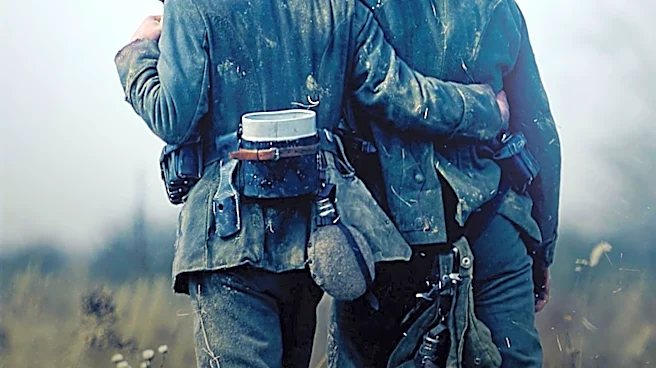
Writer-director Lukas Dhont's film 'Coward,' Belgium's official international feature submission for the 99th Academy Awards, is a World War I drama set in Belgian locations. The film focuses on a small troupe of soldiers who perform cross-dressing, morale-boosting
shows for the troops, rather than traditional combat. The narrative centers on Pierre (Emmanuel Macchia), a farm boy who discovers a queer romance with the flamboyant leader, Francis (Valentin Campagne), within the theatrical bubble. Dhont describes the film as an exploration of masculinity as a performance and how societal systems demand individuals to be performers. The film's inspiration came from historical photographs of soldiers performing in drag during the Great War, offering a counter-narrative to typical war cinema.
Why It's Important?
'Coward' contributes significantly to the U.S. and international cinematic landscape by offering a nuanced perspective on war, masculinity, and queer identity. Its submission for the Academy Awards highlights its critical acclaim and potential to reach a broad audience, fostering discussions on historical representation and LGBTQ+ themes in film. The film challenges conventional portrayals of soldiers and wartime experiences, which often focus solely on combat and traditional heroism. By emphasizing emotional truth and the internal struggles of its characters, 'Coward' can influence how war narratives are constructed and consumed, potentially encouraging more diverse storytelling in Hollywood and beyond. This shift can impact cultural perceptions of masculinity and sexuality, promoting greater understanding and empathy.
What's Next?
As 'Coward' progresses through the Academy Awards selection process, it will likely gain increased visibility and critical attention in the U.S. This exposure could lead to wider distribution in American cinemas and streaming platforms, making it accessible to a larger audience. The film's themes are expected to spark further discussions and analyses within film criticism, academic circles, and LGBTQ+ advocacy groups. Dhont's unique approach to a historical war setting may also inspire other filmmakers to explore less conventional narratives and character perspectives in future productions, potentially diversifying the types of stories told within the genre.
Beyond the Headlines
Beyond its immediate cinematic impact, 'Coward' delves into the profound psychological and sociological aspects of performance and identity, particularly in restrictive environments. The film suggests that art can serve as both an escape and a means of self-discovery, allowing individuals to explore aspects of themselves that society might otherwise suppress. The concept of 'cowardice' is subverted, questioning whether choosing life and love over death in wartime is truly a weakness. This challenges deeply ingrained societal norms about bravery, sacrifice, and conformity, particularly for men. The film's exploration of a secret queer romance in a World War I setting also sheds light on the historical invisibility of LGBTQ+ experiences, prompting a re-evaluation of past narratives and the importance of authentic representation.