

What's Happening?
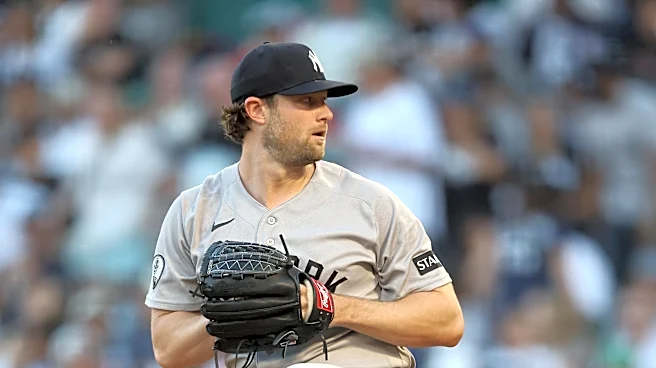
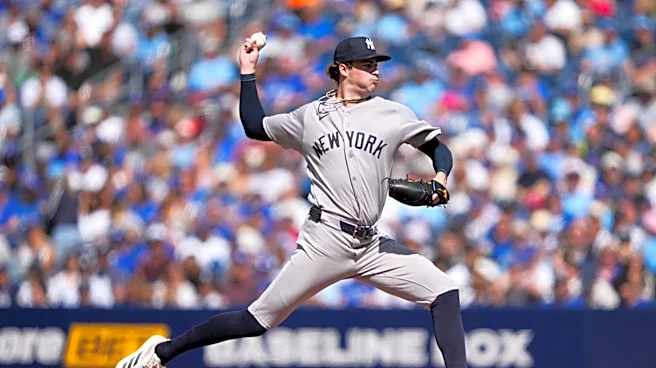
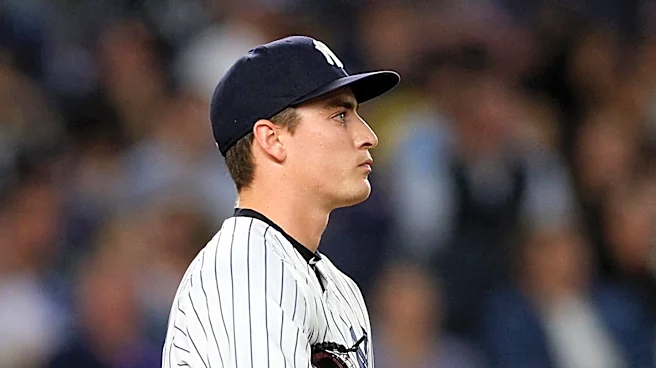
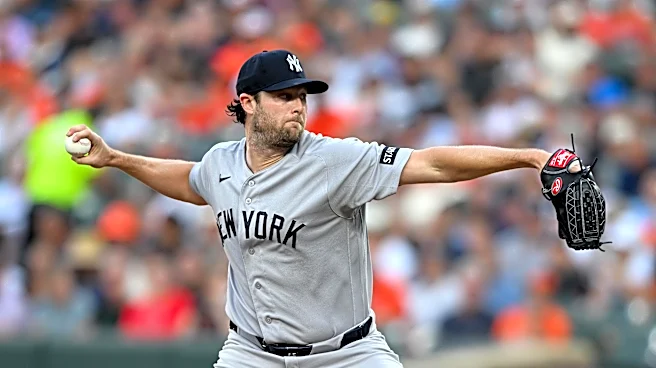
The New York Yankees are contemplating a 'piggyback' pitching strategy for Will Warren, who is currently pitching in a relief role. This approach would involve Warren pitching behind Max Fried, whose exact duration on the mound is uncertain as he returns
from a pitching elbow bone bruise. Yankees manager Aaron Boone indicated that Fried would start, likely followed by Warren. This strategy is being considered despite Warren's recent strong performance as a starter, where he threw seven innings of one-run ball against the Red Sox. The team has six starting pitchers on its roster, including rookie Elmer Rodriguez, suggesting an effort to manage pitcher fatigue for the remainder of the season. The transition to a relief role presents challenges for Warren, as it alters his warm-up routine and predictability compared to starting.
Why It's Important?
This strategic shift by the New York Yankees highlights the evolving dynamics of pitcher management in Major League Baseball, particularly for teams aiming for a deep postseason run. By implementing a 'piggyback' system, the Yankees are prioritizing pitcher health and effectiveness, especially for Max Fried, who is recovering from an injury. This approach could set a precedent for how teams utilize their pitching depth, potentially extending the careers of pitchers and mitigating injury risks. For Will Warren, adapting to a relief role after a successful starting stint is a significant professional adjustment, impacting his development and future role within the organization. The success or failure of this strategy could influence future roster decisions and pitching philosophies across the league, as teams constantly seek innovative ways to optimize performance and manage player workloads in a demanding season.
What's Next?
The Yankees are expected to implement this 'piggyback' strategy with Max Fried and Will Warren in upcoming games, starting with Fried's next scheduled start. The duration of Fried's outings will likely be closely monitored, with expectations that he could reach around 80 pitches, though no specific number has been publicly stated by the Yankees. Warren will need to adjust to the less predictable nature of a relief role, including adapting his warm-up routine for mid-game entries. Manager Aaron Boone mentioned that 'piggyback scenarios' are likely to continue, especially with upcoming doubleheaders, indicating this might be a sustained strategy rather than a one-off experiment. The team will observe how both pitchers perform under this new arrangement to determine its long-term viability and impact on their overall pitching staff.
Beyond the Headlines
The Yankees' decision to employ a 'piggyback' strategy reflects a broader trend in professional baseball towards more analytical and health-conscious pitcher management. This move challenges traditional roles of starting and relief pitchers, blurring the lines between them to maximize efficiency and protect valuable arms. While it offers benefits in terms of workload management and injury prevention, it also introduces psychological and physical adjustments for pitchers like Warren, who thrive on the routine of a starter. The success of such strategies could lead to a re-evaluation of how pitching staffs are constructed and utilized across MLB, potentially fostering a new generation of versatile pitchers capable of excelling in various roles. This innovative approach underscores the continuous search for competitive advantages in a sport increasingly driven by data and player welfare.