








What's Happening?
Researchers at the University of Chicago's Pritzker School of Molecular Engineering have developed a novel electrochemical technique for lithium extraction. Led by Associate Professor Chong Liu, the team has adapted electrochemical intercalation, a principle
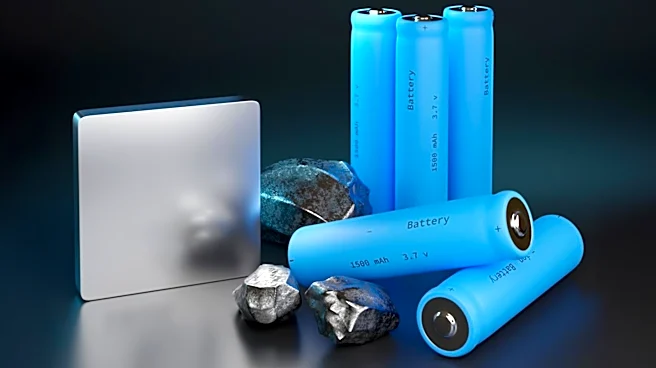
used in battery technology, to selectively capture lithium ions from aqueous solutions. This method addresses the challenge of separating lithium from sodium, which is more abundant in natural waters. The technique promises nearly pure lithium extraction, overcoming the limitations of traditional mining methods that are environmentally taxing. The research, published in Nature Communications, highlights the potential for this method to revolutionize lithium recovery, crucial for the growing demand in energy storage technologies.
Why It's Important?
The development of this electrochemical technique is significant as it offers a more sustainable and efficient method for lithium extraction, a critical component in batteries for electric vehicles and renewable energy storage. Traditional lithium mining methods are environmentally damaging, involving acid-intensive processes and significant water usage. This new method could reduce environmental impact and reliance on sensitive mining regions, addressing supply chain bottlenecks. As the demand for lithium is projected to double by 2040, innovations like this are essential for meeting global energy needs sustainably. The research also contributes to broader scientific understanding of ion transport in layered materials, with potential applications in water purification and desalination.
What's Next?
The next steps involve scaling the laboratory successes to real-world applications. Researchers are exploring the use of manganese-rich compounds as alternatives to cobalt oxide, which is currently used in the process but has limited availability and ethical concerns. The goal is to develop scalable, economically viable extraction platforms that can be deployed near diverse lithium sources. This could lead to a decentralized lithium economy, reducing environmental impact and ensuring a stable supply of this critical resource. The research also opens avenues for designing advanced materials with tailored ion-selectivities, potentially benefiting other industries.