




What's Happening?
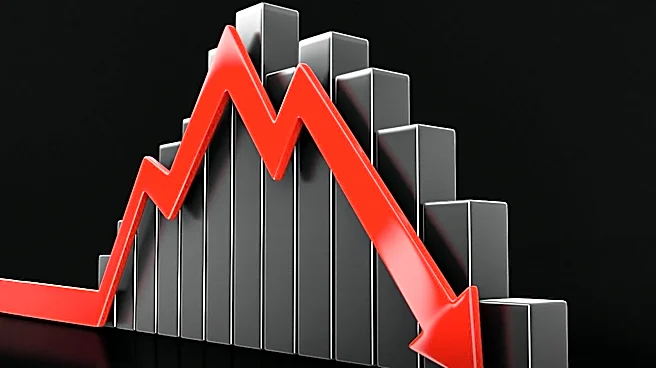
Seagate Technology, a leading manufacturer of mass-capacity hard drives, has experienced a significant 42.47% decline in its stock value over the past three months, falling from $821 to $472.33. This downturn occurred despite the company reporting robust
fiscal Q1 2027 revenue growth of 61.0% year-over-year, reaching $4.233 billion. The company's HAMR-based Mozaic platform is a key supplier for hyperscale cloud and AI data centers, driving this rapid expansion. While the latest earnings report showed non-GAAP EPS of $7.68, exceeding the $7.40 consensus by 3.74%, this was the smallest surprise in a six-quarter streak. The stock's decline is attributed to investors cutting the multiple they are willing to pay for storage hardware, a trend observed across the storage and chip stock sectors, and increased competition from rivals like Western Digital, which is also advancing its HAMR roadmap.
Why It's Important?
The substantial drop in Seagate Technology's stock, despite strong revenue growth and demand from AI and cloud data centers, highlights a broader market re-evaluation of storage hardware companies. This 'multiple compression' indicates that investors are becoming more conservative in their valuations, even for companies demonstrating significant growth. For the U.S. technology sector, this trend could signal a shift in investment priorities or a perception of increased risk within the hardware segment. The competition from Western Digital, scaling its own HAMR technology, underscores the intense rivalry in the data storage market, which could impact pricing and market share for all players. Seagate's long-term supply agreements through 2028, with some cloud deals extending to 2030, suggest a degree of stability in demand and pricing power, which could mitigate further losses and support future recovery. However, the current market sentiment reflects a cautious outlook on the sector's future profitability and growth sustainability.
What's Next?
Seagate Technology's future performance will likely hinge on its ability to maintain strong demand for its HAMR-based Mozaic platform and leverage its long-term supply agreements. With the vast majority of its Nearline Exabyte supply allocated under contracts through 2028, and some cloud deals extending to 2030, the company has a secured revenue stream that could help stabilize its stock. The tight supply in the market, where 'everything we can make above and beyond our plans is being spoken for,' is expected to support strong pricing and maintain non-GAAP gross margins, which stood at 57.8%. However, the company will need to address investor concerns regarding slower exabyte growth and the ongoing multiple compression affecting the storage and chip stock sectors. The continued scaling of HAMR technology by competitors like Western Digital will also be a critical factor, potentially intensifying competition and influencing market dynamics in the coming quarters.
Beyond the Headlines
The significant stock decline of Seagate Technology, despite its strong operational performance, reveals a deeper market sentiment regarding the valuation of hardware companies in the rapidly evolving tech landscape. This 'multiple compression' suggests that investors are increasingly scrutinizing the long-term growth potential and competitive advantages of hardware manufacturers, even those at the forefront of critical technologies like AI and cloud infrastructure. The emphasis on long-term supply agreements by Seagate highlights a strategic move to secure revenue and mitigate market volatility, reflecting a broader industry trend towards more stable, predictable business models in the face of rapid technological change. This situation also underscores the inherent tension between fundamental business strength and market perception, where even robust earnings and high demand can be overshadowed by broader economic trends or shifts in investor confidence. The ongoing competition in HAMR technology further emphasizes the relentless innovation cycle and the constant pressure on companies to differentiate and maintain their edge in the high-stakes data storage market.