





What's Happening?
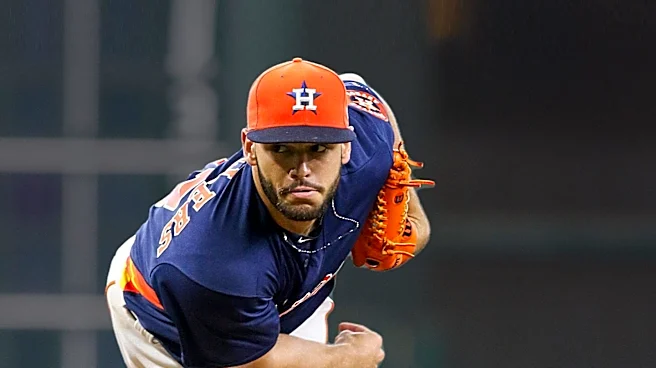
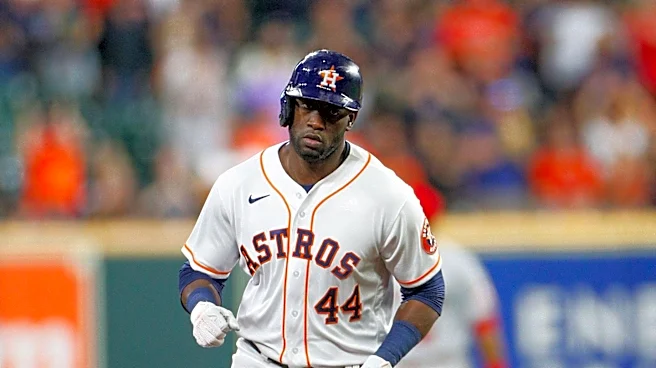
Yordan Alvarez of the Houston Astros concluded the 2026 MLB season by leading the majors in batting average, on-base percentage, and slugging percentage. He achieved a .316 batting average, a .432 on-base percentage, and a .601 slugging percentage. This
accomplishment marks him as one of only a few players in recent history to lead in all three slash-line categories, following Aaron Judge in 2025, Miguel Cabrera in 2013, Barry Bonds in 2002, and Larry Walker in 1999. Alvarez's performance included a career-high 42 home runs and a 181 wRC+, leading the majors by a significant margin. Despite his individual success, the Houston Astros finished the season 81-81 and were swept in the Wild Card Series.
Why It's Important?
Alvarez's dominant performance in 2026 highlights a growing trend of scarcity among .300 hitters in Major League Baseball. The league-wide batting average has steadily declined, with the 2026 season seeing a .244 average, matching some of the lowest figures in MLB history. Only seven qualified hitters reached .300 in 2026, a stark contrast to 55 in 1999. This shift suggests a changing offensive landscape in baseball, where elite hitters like Alvarez are becoming more exceptional. His ability to excel across multiple offensive metrics in an era of declining batting averages underscores his unique skill set and potential impact on future offensive strategies and player valuations.
What's Next?
While Alvarez's individual achievements are significant, the Houston Astros' early exit from the playoffs suggests that even top-tier individual performances may not guarantee team success. The team will likely need to address other areas to become a stronger contender in upcoming seasons. For Alvarez, maintaining this level of production will be crucial for his legacy and potential future contract negotiations. The broader trend of declining batting averages and fewer .300 hitters will continue to be a point of discussion and analysis within MLB, potentially influencing rule changes or player development strategies aimed at boosting offensive output across the league.
Beyond the Headlines
The decreasing number of .300 hitters and the overall decline in batting average could have deeper implications for the fan experience and the strategic evolution of baseball. As home runs and strikeouts become more prevalent, the traditional art of hitting for average appears to be diminishing. This shift might lead to debates about the balance between power and contact hitting, and how the game is perceived by purists versus modern analytics enthusiasts. The rarity of players like Alvarez, who can combine power with high batting averages, makes them even more valuable and could influence how teams scout and develop talent in the future, prioritizing well-rounded offensive players.