





What's Happening?
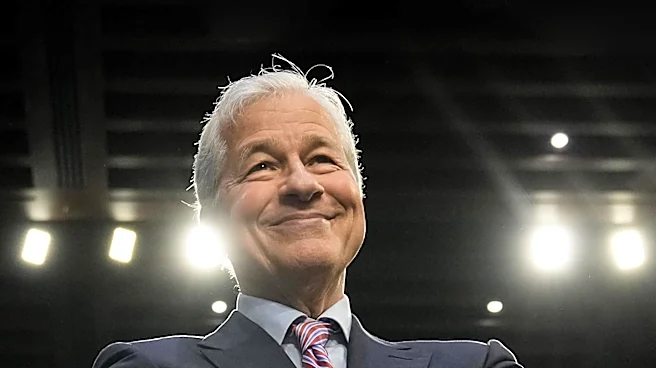
Jamie Dimon, CEO of JPMorgan Chase, has cautioned financial institutions against allowing autonomous AI agents to handle banking payments, citing their 'treacherous' risk. This warning comes amidst a backdrop of increasing cyber threats, highlighted by
recent high-profile attacks such as the $6.3 billion hack on Binance and a €100 million ($112 million) breach at French lender Crédit Mutuel Arkéa. While some European banks like Santander and ING permit AI agents for payments with customer-set limits or approvals, U.S. banks like Citigroup and Bank of America, along with U.K. banks such as HSBC and Barclays, have restricted agents from accessing customer accounts. Dimon's concerns underscore the vulnerabilities in traditional financial institutions, which, despite regulatory advantages, are not necessarily better at preventing cyberattacks than crypto platforms. Experts point to banks' reliance on long chains of outside suppliers and aging technology as key weak spots.
Why It's Important?
Dimon's strong stance on autonomous AI agents in banking payments is critical for the U.S. financial sector, emphasizing the need for robust cybersecurity measures as AI technology advances. The recent cyberattacks on both crypto exchanges and traditional banks demonstrate that no financial entity is immune to sophisticated threats. For U.S. banks, this warning reinforces the imperative to invest heavily in cybersecurity infrastructure and to carefully evaluate the risks associated with integrating AI into core operations, particularly those involving financial transactions. The reliance on third-party suppliers and outdated IT systems, as highlighted by experts, presents systemic vulnerabilities that could lead to significant financial losses and reputational damage. This situation could prompt increased regulatory scrutiny and a push for more stringent guidelines on AI deployment in banking, impacting how financial services are delivered and how customer data is protected.
What's Next?
The increasing cyber threats and Dimon's warning are likely to accelerate discussions within the U.S. financial industry and among regulators regarding the safe and responsible implementation of AI. Banks may face pressure to enhance their cybersecurity protocols, conduct more thorough risk assessments for AI applications, and potentially restrict the autonomy of AI agents in sensitive financial operations. The Federal Reserve and the Office of the Comptroller of the Currency have already begun inquiring about unusual activity and service disruptions, indicating a heightened focus on cyber resilience. This could lead to new industry standards or regulatory frameworks specifically addressing AI in banking. Financial institutions will need to balance the efficiency gains offered by AI with the critical need to protect against sophisticated cyberattacks, potentially leading to a more cautious and phased approach to AI adoption in payment systems.
Beyond the Headlines
The debate over AI's role in banking payments extends beyond immediate security concerns to broader ethical and systemic implications. The 'treacherous' risk cited by Dimon touches upon the potential for AI to be exploited by malicious actors, leading to unprecedented levels of financial fraud and instability. This raises fundamental questions about accountability when autonomous systems are involved in financial decisions. The vulnerability of aging IT systems in banks, juxtaposed with the rapid advancement of AI, creates a complex challenge for maintaining financial integrity in the digital age. Furthermore, the comparison between crypto exchanges and traditional banks in terms of security highlights that technological innovation, while offering new solutions, also introduces new vectors for attack. This ongoing struggle between technological progress and cybersecurity threats will likely shape the future of financial regulation and the public's trust in digital banking systems.