

What's Happening?
The Philippines has secured P41.1 billion (approximately $700 million USD) in investment pledges from various Chinese firms following President Marcos's meetings in Shenzhen, China. These commitments are expected to generate over 7,000 new jobs for Filipinos.
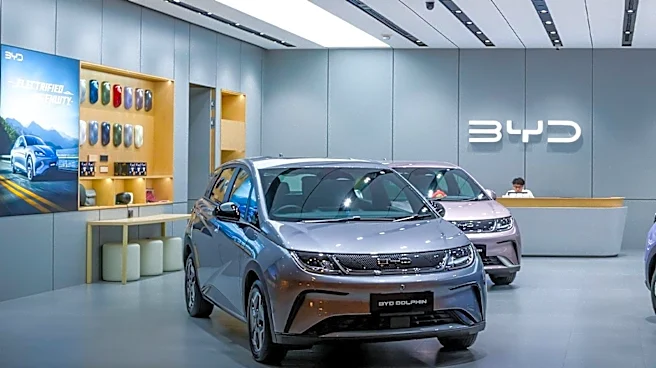
Key discussions included a meeting with BYD founder and chairman Wang Chuanfu, along with representatives from Ayala Corporation and ACMobility, to explore opportunities in the electric vehicle industry. President Marcos expressed the nation's ambition to not only increase EV adoption but also to build a domestic EV industry, attract new technologies, and make cleaner transportation accessible. Additionally, Chinese bearing manufacturer C&U Group committed an initial $87 million to establish a 20-hectare manufacturing facility in Alitagtag, Batangas. This facility is envisioned to become C&U Group's largest production base outside China and its sole manufacturing facility in Southeast Asia. Other firms like TCL Group, Huaxin Building Materials Group, Shenzhen Grandsun Electronic, and PCON International also participated in an executive roundtable to advance expansion plans and align investment opportunities with the Philippines’ industrial and manufacturing priorities. Marcos also met with Ming Yang Smart Energy Group to discuss investments in offshore wind energy infrastructure.
Why It's Important?
These investment pledges are significant for the Philippine economy, signaling continued investor confidence despite global economic challenges. The P41.1 billion in commitments, particularly in manufacturing and renewable energy, are poised to create substantial employment opportunities, directly benefiting over 7,000 Filipino workers. The focus on the electric vehicle industry, with BYD's involvement, could position the Philippines as a key player in the regional EV supply chain, fostering technological advancement and sustainable transportation solutions. C&U Group's investment in a large-scale bearing manufacturing facility in Batangas underscores the Philippines' growing appeal as a manufacturing hub, potentially attracting further foreign direct investment and diversifying the country's industrial base. The discussions with Ming Yang Smart Energy Group also highlight the Philippines' commitment to clean energy transition and long-term energy security, which could reduce reliance on fossil fuels and mitigate climate change impacts. These investments collectively contribute to the nation's economic growth, industrial modernization, and job creation initiatives.
What's Next?
Following these investment pledges, the next steps will involve the formalization and implementation of the discussed projects. For BYD and its partners, further detailed plans for developing the electric vehicle industry in the Philippines are expected, potentially including timelines for manufacturing facilities, charging infrastructure, and market penetration strategies. C&U Group will likely proceed with the development of its 20-hectare manufacturing facility in Batangas, with construction and operational timelines to be established. The Philippine government will need to ensure a conducive regulatory environment and provide necessary support to facilitate the smooth execution of these investments. Monitoring the progress of these projects will be crucial to assess their impact on job creation and economic growth. Additionally, discussions with Ming Yang Smart Energy Group on offshore wind energy infrastructure will likely advance, potentially leading to concrete project proposals and development plans to bolster the Philippines' renewable energy capacity. The government may also continue to engage with other foreign investors to capitalize on the momentum generated by these recent commitments.
Beyond the Headlines
The influx of these investments extends beyond immediate economic gains, hinting at broader strategic shifts for the Philippines. The emphasis on electric vehicles and renewable energy aligns with global sustainability goals and could transform the country's energy landscape, reducing its carbon footprint and enhancing energy independence. This strategic pivot could also foster a skilled workforce in emerging industries, driving innovation and technological transfer. The establishment of major manufacturing hubs, such as C&U Group's bearing facility, could integrate the Philippines more deeply into global supply chains, increasing its resilience to economic shocks. Furthermore, these partnerships with Chinese firms could strengthen bilateral economic ties, potentially influencing regional trade dynamics and geopolitical relationships. The government's proactive approach in attracting foreign investment, coupled with policy changes, signals a long-term vision for economic diversification and modernization, aiming to elevate the Philippines' standing as a competitive investment destination in Southeast Asia. The success of these ventures will serve as a crucial test case for future foreign direct investment initiatives.