




What's Happening?
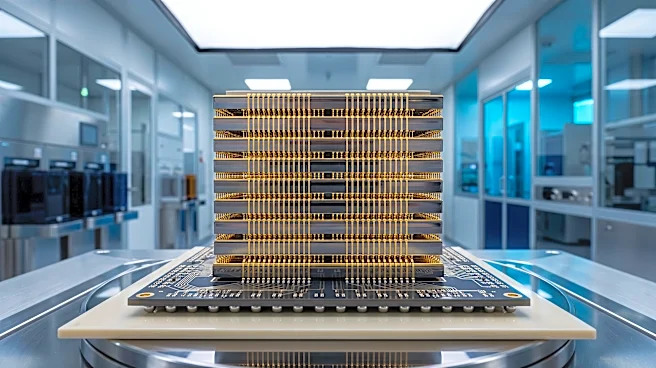
Micron Technology and ON Semiconductor are identified as key players in the burgeoning AI hardware market, driven by significant corporate investment in AI. Micron Technology specializes in supplying DRAM and NAND memory, including high bandwidth memory (HBM)
crucial for AI servers, GPUs, and data center accelerators. Its revenue primarily stems from cloud, data center, and mobile segments. ON Semiconductor focuses on power and sensing chips that enhance the efficiency of AI data centers, electric vehicles, and industrial systems. Its portfolio includes AI-linked power solutions, with revenue led by its Power Solutions Group, followed by Analog & Mixed-Signal and Intelligent Sensing divisions. Both companies are integral to the AI supply chain, with Micron providing essential memory components and ON Semiconductor ensuring stable and efficient energy delivery to AI processors. The current corporate earnings growth, largely fueled by tech companies' AI hardware spending, highlights the increased demand for these semiconductor components.
Why It's Important?
The roles of Micron Technology and ON Semiconductor are critical to the continued expansion and efficiency of the AI industry. Micron's high bandwidth memory (HBM) is becoming a pivotal component in AI server design, transforming memory from a background element into a core necessity for feeding AI accelerators with sufficient data. This shift underscores the increasing demand for specialized memory solutions to keep pace with the computational demands of AI. ON Semiconductor's power management and mixed-signal hardware are essential for the stable and efficient operation of AI processors, ensuring that these powerful chips receive reliable energy. The performance and availability of components from these companies directly impact the development and deployment of AI technologies across various sectors, from cloud computing to autonomous systems. Their contributions are fundamental to the infrastructure supporting the current AI boom, making them significant indicators of the industry's health and future direction.
What's Next?
The ongoing surge in AI hardware investment is expected to continue driving demand for specialized components from companies like Micron Technology and ON Semiconductor. Micron's focus on HBM suggests continued growth as AI accelerators become more prevalent, potentially leading to further advancements in memory technology to meet increasing bandwidth requirements. For ON Semiconductor, the need for efficient power management in AI data centers and other AI-driven systems will likely sustain demand for its power and sensing chips. Both companies are positioned to benefit from the sustained spending spree by large tech groups on AI infrastructure. However, potential shifts in the balance between supply and AI-led demand, as well as broader economic factors, could influence their future earnings power and market valuations. Monitoring trends in AI development and data center expansion will be crucial for understanding the trajectory of these companies.
Beyond the Headlines
The prominence of Micron Technology and ON Semiconductor in the AI supply chain highlights a broader trend in the technology sector: the increasing specialization and interdependence of hardware components. The AI revolution is not solely about advanced processors but also about the entire ecosystem that supports them, including high-performance memory and efficient power delivery. This interdependence means that bottlenecks or innovations in one area, such as memory bandwidth or power efficiency, can have significant ripple effects across the entire AI industry. Furthermore, the focus on these foundational components underscores the substantial capital expenditure required to build and maintain AI infrastructure, suggesting that companies providing these essential building blocks will remain critical. The ongoing evolution of AI will likely continue to drive innovation in these underlying hardware segments, pushing the boundaries of what is possible in computing and data processing.