




What's Happening?
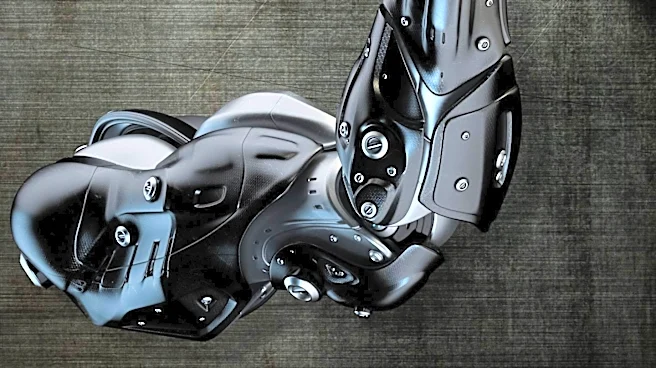
Sòphia High Tech, an Italian aerospace and defense company, has introduced a robotic arm named ROMAN, designed for the inspection and maintenance of nuclear fusion reactors. This development is part of a collaboration with the University of Naples Federico
II and Herobots, focusing on environments where human operation is not feasible. ROMAN is engineered to work within the RFX-mod2 fusion experiment, where it can withstand extreme temperatures of up to 20 million °C. The robotic arm is capable of identifying, removing, and reinstalling graphite tiles, as well as performing visual inspections and cleaning operations. This project marks Sòphia HT's expansion into the nuclear domain, leveraging its precision-engineering capabilities previously applied in aerospace and defense sectors.
Why It's Important?
The introduction of ROMAN signifies a significant advancement in the field of nuclear fusion technology, a sector critical for future energy solutions. By enabling maintenance in environments too hazardous for humans, ROMAN enhances the safety and efficiency of nuclear fusion research. This development also highlights the potential for cross-industry applications of aerospace and defense technologies, showcasing how precision engineering can be adapted for use in energy infrastructure. For Sòphia HT, this project not only diversifies its portfolio but also strengthens its position in the highly regulated and mission-critical market of nuclear technology, aligning with Genenta's strategy to build an industrial platform across sectors central to national technological sovereignty.
What's Next?
Sòphia HT's successful deployment of ROMAN could lead to further applications of robotic technology in other hazardous environments, potentially expanding its market reach. The company may explore additional partnerships and projects within the nuclear sector, leveraging its expertise in precision mechanics and robotics. As Genenta Science evolves into Saentra Forge, there may be increased focus on consolidating capabilities across aerospace, defense, and nuclear sectors, potentially leading to new innovations and industrial growth. The success of ROMAN could also prompt other companies to invest in similar technologies, driving advancements in nuclear fusion research and energy independence.