







What's Happening?
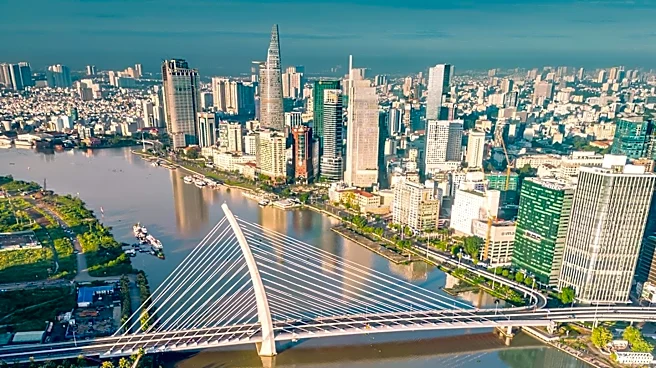
Ho Chi Minh City is embarking on a 100-year master plan (2025-2050, with a vision to 2125) to transform into a multipolar, multi-centered megacity. This ambitious plan follows a historic administrative boundary merger, expanding the city's natural area
and projecting a population of 22-23 million by 2050. The core objective is to shift from a single-centered urban model to one that integrates and synchronizes development across space, infrastructure, and socio-economic aspects, aiming to maximize synergistic effects and create outstanding added value. Key proposals include developing a multimodal logistics system, multimodal transportation infrastructure, and Transit-Oriented Development (TOD) urban corridors linked to the '15-minute city' model. The plan also emphasizes reorganizing development space, population distribution, and economic functions, while building a synchronous and modern transportation and technical infrastructure system.
Why It's Important?
This master plan for Ho Chi Minh City holds significant implications for urban development and economic growth, offering substantial opportunities for U.S. businesses and expertise. The shift to a multipolar model, coupled with extensive infrastructure development, creates a demand for advanced urban planning, smart city technologies, and sustainable construction solutions, areas where U.S. companies often excel. The emphasis on multimodal logistics and transportation infrastructure could attract U.S. investment in supply chain management, port development, and public transit systems. Furthermore, the '15-minute city' concept and TOD corridors align with global trends in sustainable urban living, potentially opening doors for U.S. firms specializing in green building, urban design, and community development. For the U.S., engaging with such large-scale urban transformations can foster economic partnerships, promote technological exchange, and strengthen diplomatic ties, while also providing valuable insights for addressing similar urban challenges domestically.
What's Next?
The immediate next steps for Ho Chi Minh City involve refining the draft master plan based on social critique and expert opinions. The city will need to establish a strategic framework for reorganizing development space, population distribution, and economic functions. A critical challenge will be to strengthen the justification for and ability to mobilize investment resources, clearly defining project priorities and capital requirements. This includes assessing the plan's alignment with the city's economic scale, budget revenue collection capabilities, and ability to attract external resources. The city is expected to pilot the TOD urban model along Metro Line 1 to create a template for broader replication. Additionally, there will be a focus on identifying and preserving historical centers while integrating economic and financial hubs through TOD connections. The plan also calls for dividing the city's space into different groups, designating areas for growth poles and strategic infrastructure, and controlling high-risk areas.
Beyond the Headlines
The 100-year master plan for Ho Chi Minh City, aiming for a multipolar megacity, carries profound ethical, social, and environmental implications. Ethically, the massive scale of development raises questions about equitable displacement, affordable housing, and ensuring that all segments of the population benefit from urban growth, not just the affluent. Socially, the transition to a multipolar model and '15-minute cities' could fundamentally alter community structures, daily routines, and social interactions, requiring careful planning to foster inclusivity and maintain cultural heritage. Environmentally, managing the impact of such extensive urbanization on natural ecosystems, air quality, and water resources will be a critical long-term challenge, especially in a region vulnerable to climate change. The plan's success will depend not only on economic and infrastructural achievements but also on its ability to create a truly livable, sustainable, and equitable urban environment for its projected 22-23 million residents, setting a precedent for future megacity developments globally.