





What's Happening?
Chinese EV manufacturer Xpeng has officially inaugurated its automated production line for humanoid robots, marking a significant shift from prototype development to mass production. The company unveiled its general-purpose humanoid robot, 'IRON,' which
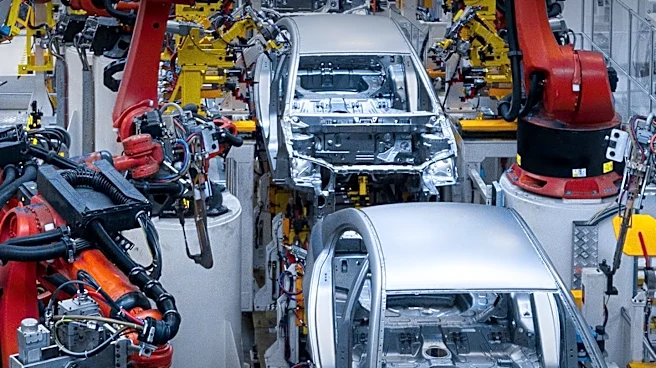
stands 178cm tall and is designed to perform various tasks. Xpeng's CEO, He Xiaopeng, emphasized that the company has automated over 80% of core production processes, claiming it to be the world's first automated production line for advanced humanoid robots. The company aims to produce 1,000 IRON units per month by year-end, with initial deployment in its own retail stores for customer service roles. External sales in China and international markets are planned to commence next year. This move is notable as an automaker, rather than a traditional robotics specialist, is leading both the development and mass production of humanoid robots.
Why It's Important?
Xpeng's entry into mass-producing humanoid robots, leveraging its automotive manufacturing capabilities, could significantly disrupt the robotics industry. By sourcing over 85% of IRON components from existing automotive suppliers, Xpeng demonstrates a structural advantage in cost competitiveness and supply chain efficiency that traditional robotics companies may lack. This approach allows Xpeng to build robots more cheaply and quickly, potentially accelerating the widespread adoption of humanoid robots. The integration of self-developed AI chips, such as the 'Turing' AI chip, further enhances cost-effectiveness and performance. This development highlights a growing trend where established industries, like automotive, are diversifying into advanced technological fields, bringing their expertise in mass production and supply chain management to new sectors. The success of this model could set a precedent for other automakers and manufacturing giants to enter the humanoid robot market, intensifying competition and innovation.
What's Next?
Xpeng plans to begin mass production of 1,000 IRON units per month by the end of the year. These robots will initially be deployed in Xpeng's own retail stores for customer service, serving as a practical testing ground and demonstration of their capabilities. The company intends to expand sales to external customers in China and overseas markets starting next year. This phased rollout suggests a strategic approach to refine the product and gather user feedback before a broader market release. The company's robotics division recently secured $900 million in funding from investors including IDG Capital, Tencent, and Alibaba, indicating strong financial backing for its ambitious plans. This funding, the largest single-round private fundraising in China's physical AI sector to date, will likely fuel further research, development, and expansion of production capabilities, potentially leading to more advanced models and wider applications for IRON robots.
Beyond the Headlines
The convergence of automotive manufacturing and advanced robotics, as exemplified by Xpeng, points to a broader shift in industrial capabilities. The CEO's statement, "Cars and robots are not two parallel lines; rather, the same physical AI capabilities are extended into different bodies," underscores a fundamental re-evaluation of how AI and automation can be applied across diverse physical platforms. This integration of AI semiconductors and existing supply chains could lead to a rapid commoditization of humanoid robots, making them more accessible and affordable for various industries beyond customer service, such as logistics, healthcare, and even domestic applications. The ethical implications of widespread humanoid robot deployment, including job displacement and the nature of human-robot interaction, will become increasingly pertinent. Furthermore, the competition between automakers and traditional robotics specialists in this emerging market could drive significant advancements in both hardware and AI, pushing the boundaries of what autonomous systems can achieve.