






What's Happening?
U.S. warehouses are undergoing a significant operational shift with the adoption of Goods-to-Person (GTP) technology, aiming to enhance productivity and address challenges related to labor availability and operating costs. Traditionally, warehouse workers
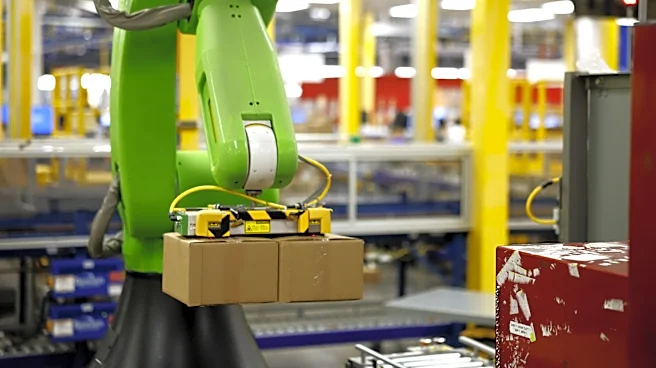
spend considerable time walking to locate and pick products. GTP systems reverse this process by bringing inventory directly to workers' workstations through automated means. This includes autonomous mobile robots (AMRs) transporting shelves, automated storage and retrieval systems (AS/RS) delivering products to picking stations, and conveyor systems moving goods between operational zones. This technological integration is becoming a priority for U.S. businesses seeking to improve efficiency without expanding physical warehouse space, especially as order volumes increase and delays accumulate from manual processes.
Why It's Important?
The implementation of Goods-to-Person technology is crucial for the future of U.S. manufacturing and warehousing. By minimizing the time workers spend walking, GTP systems significantly boost operational efficiency and throughput, directly impacting fulfillment expectations and overall operating costs. This is particularly important given rising labor costs and the ongoing challenge of labor availability in the warehousing sector. The technology allows warehouses to handle higher order volumes with fewer errors and at a lower cost, making U.S. businesses more competitive. It also represents a strategic investment that can reduce the need for constant expansion of physical warehouse space, which is becoming increasingly expensive. The shift towards intelligent product delivery rather than worker movement is a fundamental change that can redefine productivity standards in the industry.
What's Next?
The adoption of Goods-to-Person technology is expected to become a standard for modern U.S. warehouses. Future developments will likely focus on further integrating inventory management, warehouse software, robotics, and human workflows into seamless, efficient systems. This will involve continuous innovation in AMR and AS/RS technologies, as well as advanced analytics to optimize product flow and worker assignments. The trend suggests a move towards more automated and data-driven warehouse environments, where human workers collaborate with intelligent systems to achieve higher levels of productivity. Companies that embrace these integrated solutions will likely gain a competitive edge in terms of speed, accuracy, and cost-effectiveness.
Beyond the Headlines
The transition to Goods-to-Person technology has deeper implications for the U.S. workforce and the nature of warehouse jobs. While automation can increase efficiency, it also necessitates a re-skilling of the labor force, shifting roles from manual picking to overseeing and maintaining automated systems. This could lead to a demand for workers with more technical skills in robotics, software operation, and system maintenance. Furthermore, the reduced physical strain on workers could improve workplace safety and job satisfaction. The widespread adoption of GTP could also influence urban planning and real estate development, as warehouses might require different layouts and less expansive footprints, potentially impacting land use and logistics infrastructure in various regions.